Lunt Meadows is an iconic wetland nature reserve located in Merseyside. The site itself is a prime example of the value of rewilding. Just over a decade ago, Lunt Meadows as we know it today didn’t exist. Instead, it was heavily farmed arable land, void of life. Now, it is a haven for countless species, both native and migratory.
Winter is an incredible time to visit Lunt Meadows; you truly never know what you might see from one day to the next. The only difficult part is finding a gap in the relentless, unsettled weather. Lucky for me, a recent rare morning of settled weather provided the perfect conditions for a trip to the reserve. If you love wildlife photography, grab a brew; this one is for you.
As of writing this, parking at Lunt Meadows is no longer free. All-day parking between 9 AM and 5 PM is available on-site for £4, which helps to fund invaluable conservation work.
The Dawn Chorus of Lunt Meadows
The first thing you notice walking around Lunt Meadows at dawn is the alluring chorus of bird calls in all directions. This is amplified throughout late autumn and early winter as migratory birds begin to arrive in large numbers. It’s a magical time of morning to be out with your camera.
At dawn, your senses seem heightened, especially your eyes, which become finely tuned, allowing you to spot silhouettes of birds flying by. If you haven’t experienced photography during blue hour, you might be of the impression that there isn’t enough light. Whilst somewhat true, this doesn’t mean that you can’t capture captivating images. With a little care and consideration of camera settings and technique, you can absolutely capture the magic of the blue hour.
One chorus which stands out above all is that of the geese. From behind one of the nature screens, I noticed random groups of them flying across the reserve and landing near the surrounding lakes. It was the perfect opportunity to practice my panning technique using a slow shutter speed.
Panning for Success
For those who don’t know, panning with a slow shutter speed is a technique that can be used to illustrate movement. The best part is that, because you are using relatively low shutter speeds, it can be done in fairly low light conditions. The technique can be carried out by following your subject’s movement with your camera whilst using a slow shutter speed and a narrow aperture to capture images. This works best when subjects are moving parallel to you, therefore allowing you to maximise your depth of field and track your subject more efficiently.
To pan with your subject, adopt a solid stance, holding your camera and lens supportively and twist your body to follow the movement of your subject to track it as it moves parallel to you. Ideal shutter speeds vary depending on the speed of your subject, but you can experiment with anything between 1/30th and 1/100th.
To increase your depth of field and the success rate, it’s best to stop down your aperture by at least one or two stops. When tracking your subject, ensure you are using subject tracking and high burst mode to increase the chances of capturing a sharp image. There will inevitably be a number of blurry images, but hopefully, throughout the burst, you match the speed of your subject and nail the photograph.
The “Impostor”
In the example below, I spotted a small group of geese (three Canadian and a Greylag). As they neared, I quickly adjusted my camera settings to manual mode, 1/60th second, ISO 640, F/8 and set my lens to 400mm. 1/60th is obviously an incredibly slow shutter speed for photographing moving birds; however, I matched the birds’ movement speed by panning with my camera and was able to capture a pleasing photograph. The result is an image which captures the movement of the wings whilst keeping the bodies and head fairly sharp.
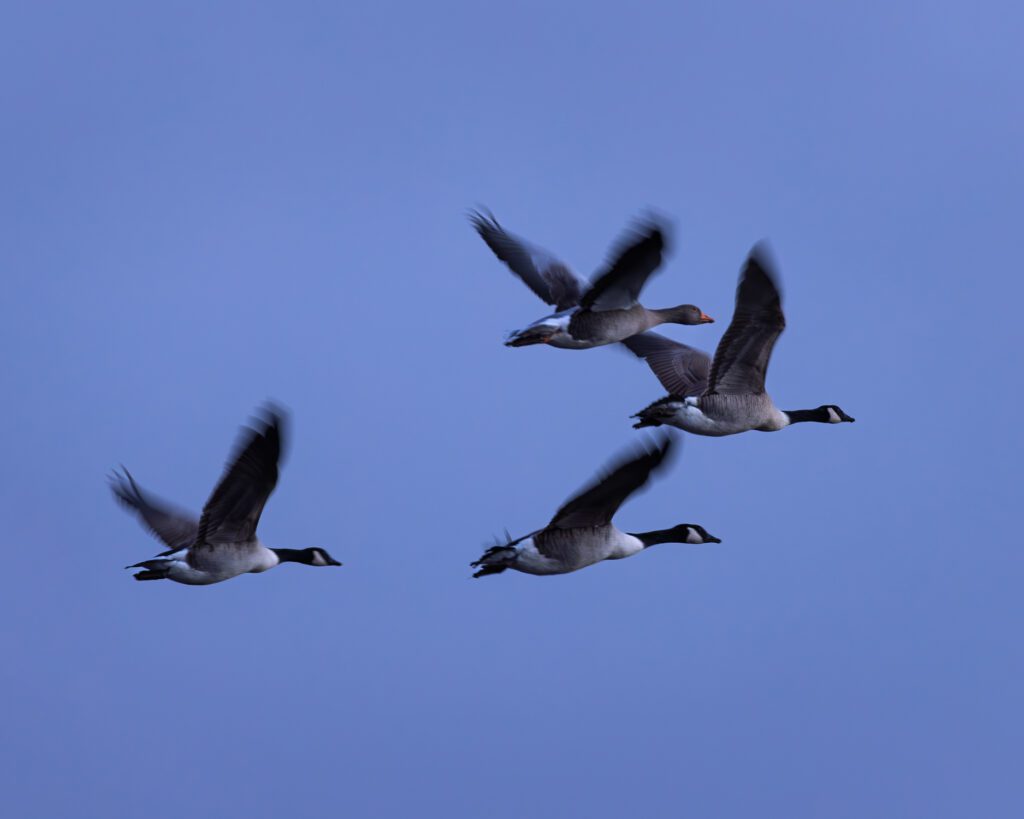
Above: one of many small groups of geese moving around Lunt Meadows before sunrise. The image was captured using a panning technique with a slow shutter speed to capture the wing movement. In this image, my focus was on the Greylag goose as the “impostor” of the group.
A Radiant Sunrise over Lunt Meadows
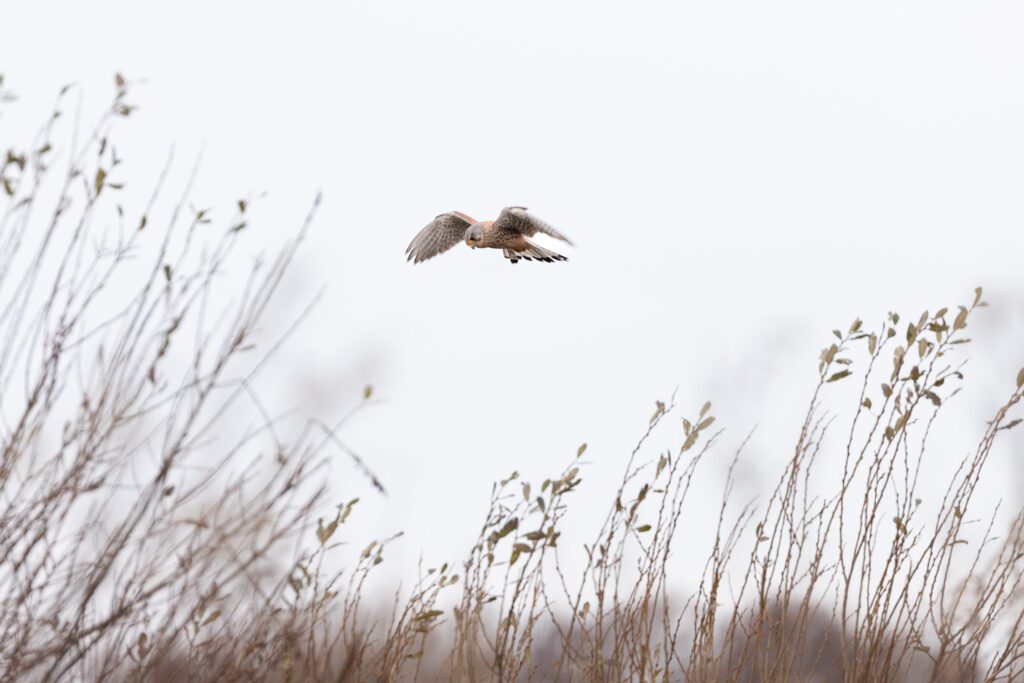
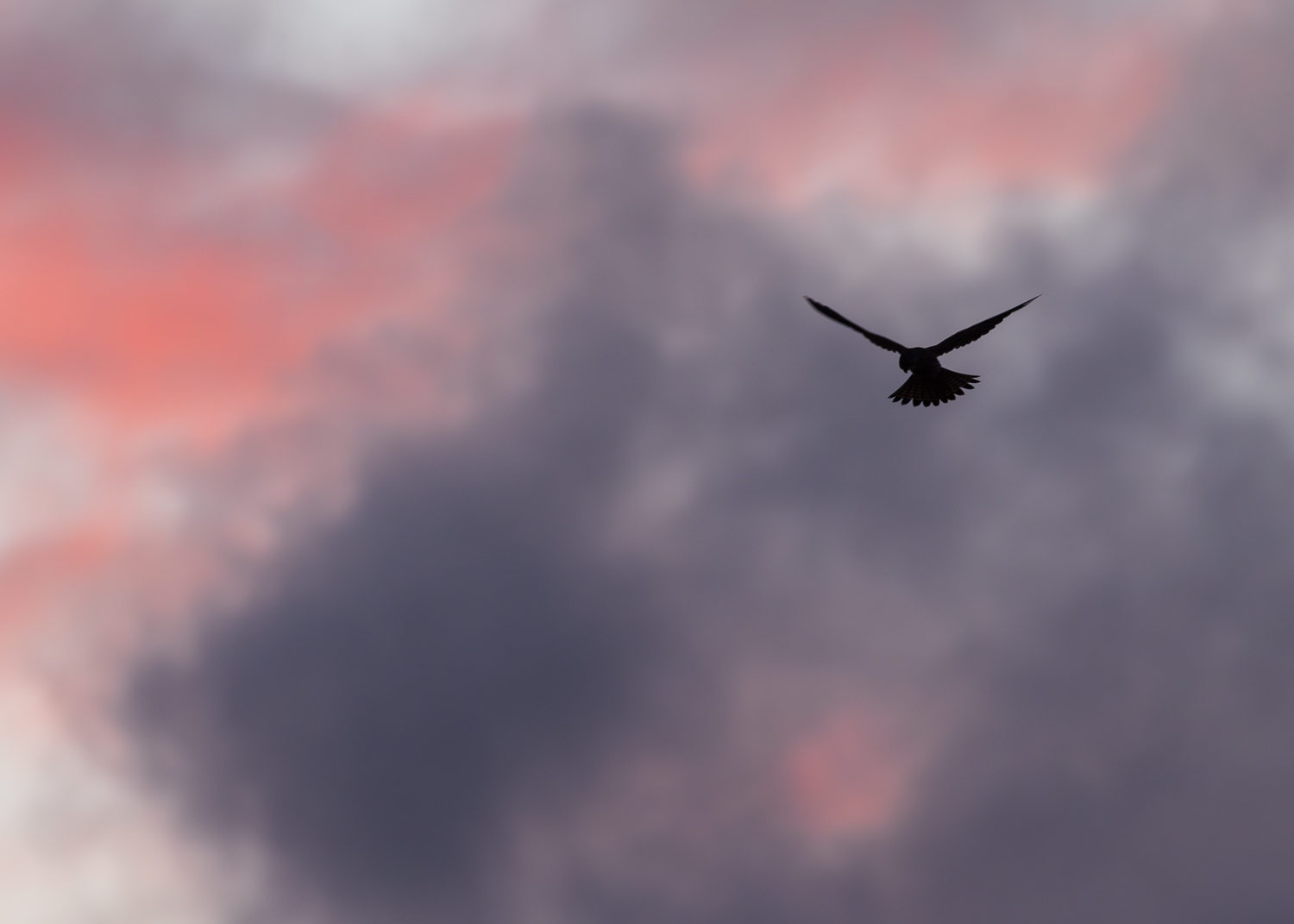
One style of photograph I love to capture during the early hours is a silhouette. It’s hard to beat a pleasing sky coupled with the unmistakable silhouettes of Lapwings. Throughout the early hours, these energetic birds can be seen flying in small circuits across Lunt Meadows. Occasionally, you can catch them warning off predators both vocally and physically. Not long after capturing the image below, I witnessed a group (aka a deceit) of Lapwings dive bomb a nearby hovering Kestrel.
There wasn’t really anything too technical about this image other than exposing for the sky to avoid clipping highlights. Top tip: keep an eye on your histogram and ensure the data isn’t pushed too far to the right.
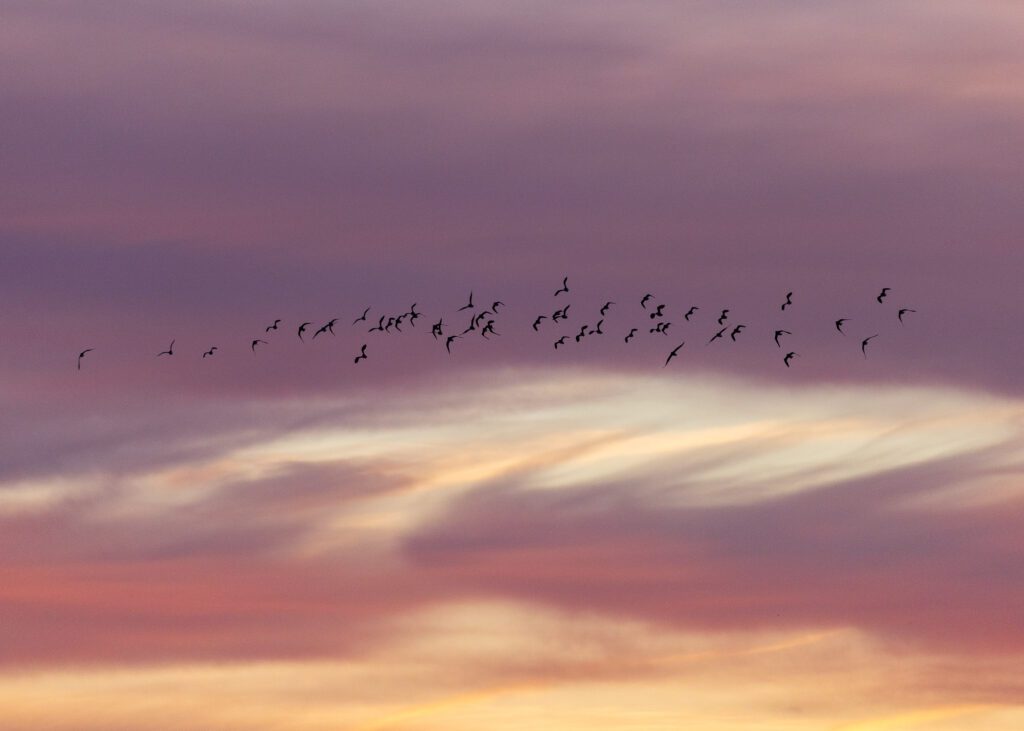
Above: glorious sunrise colours fill the sky as a group of Lapwings fly around the reserve. Camera settings, 1/1000th, F/5.6, 1/1000th.
Experiencing the Unknown
After the sun had risen, the landscape was flooded with gorgeous golden light. As a result, light levels increased dramatically, allowing me to venture around the reserve and admire the wildlife. I didn’t have a plan, I wasn’t looking for any specific species, and sometimes that’s exactly what is needed.
Over the past few months, I’ve found myself fixated on specific species such as barn owls and kingfishers. When I start a project, I do whatever it takes to see it through. Barn owls, for example, I couldn’t tell you how long I have spent in local fields sitting in a bush and observing. Hours upon hours over the course of months to build a clear picture of behaviour and patterns that could lead to a future dream photograph. Fieldcraft is a tedious process, yet unbelievably rewarding. That said, it was nice to enjoy a morning of the unknown.
The Beautiful Male Kestrel
It wasn’t long before I came across a familiar subject, a male kestrel. I’m almost certain this was the same kestrel that had been dive-bombed by the lapwings earlier on. I will admit, I almost missed him thanks to his incredible camouflage against the surrounding golden grasses. Luckily, I noticed just in time and managed to stop around 20 metres from him. He seemed happy enough that I wasn’t an immediate threat and remained perched. I slowly raised my camera and captured a gorgeous frame of him basking in the beautiful golden light.
It’s not often I get the opportunity to photograph a perched kestrel at eye level. Typically, they are perched higher up on telephone line poles or way up in trees. From a technical standpoint, there wasn’t really anything too difficult to watch out for. Key considerations included using a fast shutter speed to eliminate motion blur (which isn’t a problem with good light) and management of depth of field to remove background distractions.

Above: a beautiful male kestrel basking in gorgeous golden light captured at 1/2500th, F/5.6, ISO 400.
The Mighty Wren
Continuing my walk around Lunt Meadows towards the viewing screen across the water pump lake, I encountered yet another classic UK bird species, the mighty wren. These beautiful birds are often difficult to photograph due to their small size and jittery nature. They like to move around a lot. Typically, they forage in dense undergrowth, making photography a challenge. To my surprise, this wren in particular stayed perched on the fence post long enough to allow me to capture a quick portrait.
Similar to the kestrel, a fast shutter speed was required to freeze any movement. Not long after capturing this photograph, the wren flew away. I was happy to have not been caught off guard for once! Keeping your camera accessible in locations such as Lunt Meadows will pay dividends, especially as you don’t know what you might see and, more importantly, when.
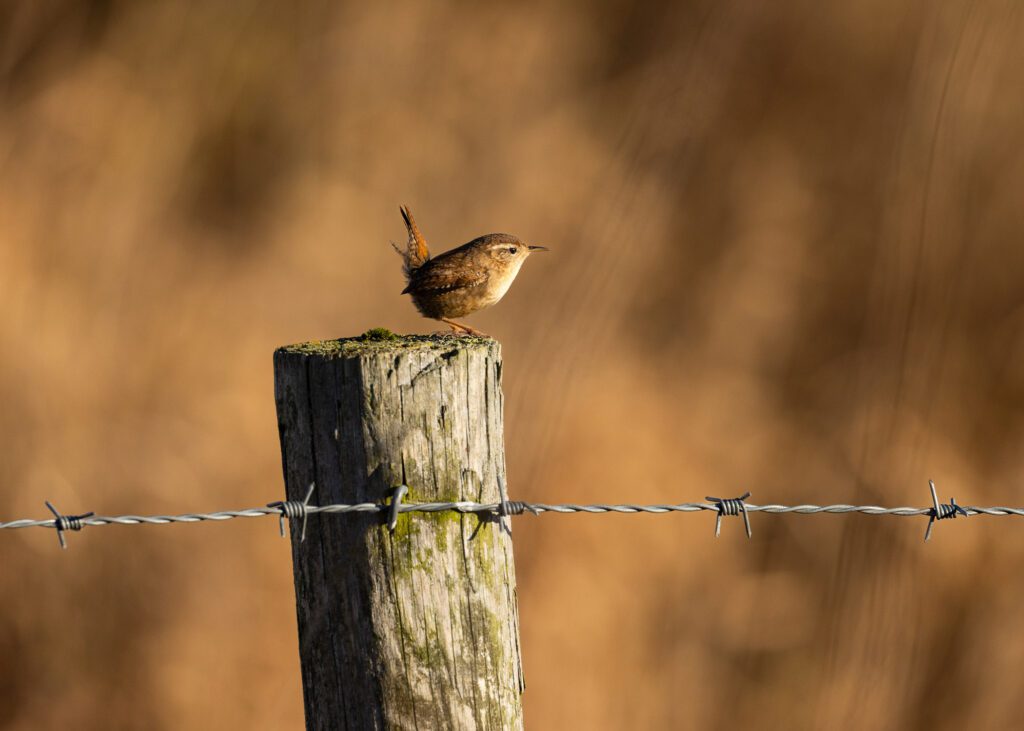
Above: the small but mighty wren perched on a fence post during golden hour. Captured at 1/2500th, F/5.6, ISO 400.
An Intimate Moment with a Little Egret
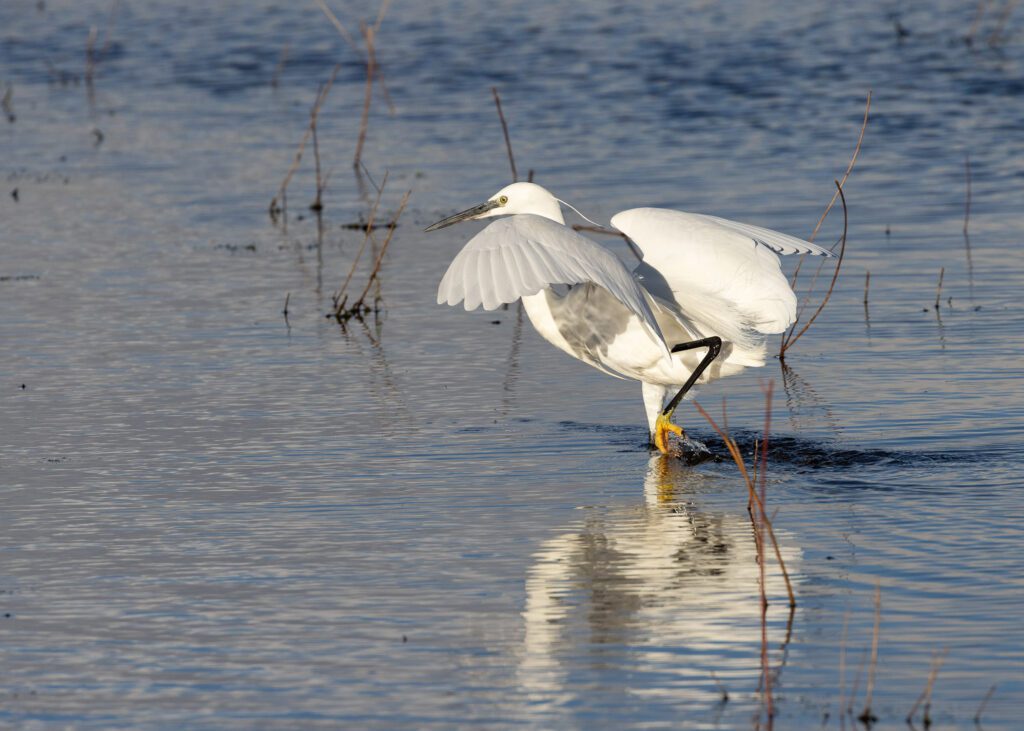
As the morning progressed, the golden light became less saturated. However, one of the joys of winter light is that it’s usable almost all day long! Stopping at one of the small pools, I noticed a little egret wading in the shallow waters amongst the reeds. It was on the prowl for fish. I positioned myself close to the fence surrounding the water and got down as low as I could. It was a waiting game now. By staying as still as possible, I waited to see what the little egret would do. It didn’t seem phased by my presence and continued wading around the shallow water, working its way closer towards me.
I was hoping it would successfully catch a fish and offer an action shot in the process. On a couple of occasions, it seemed close, but no joy. Instead, I set about making the most of the scene in front of me. If any scene suited monochrome, it was this one. A beautifully illuminated white bird against the darker water with surrounding reeds. Perfection. I exposed for the little egret and its illuminated feathers, and waited for the perfect moment.
The moment arrived when it adjusted its position slightly, causing a ripple on the water. The texture was beautiful, subtly breaking up the reflection of the little egret on the water’s surface. This was, without a doubt, my favourite photograph of the morning, and I hope you enjoy it as much as I did whilst capturing it. For this image, I used spot metering to ensure that my subject was correctly exposed. I wasn’t worried about the rest of the scene, knowing that a slightly darker environment would only add contrast to my monochrome image.
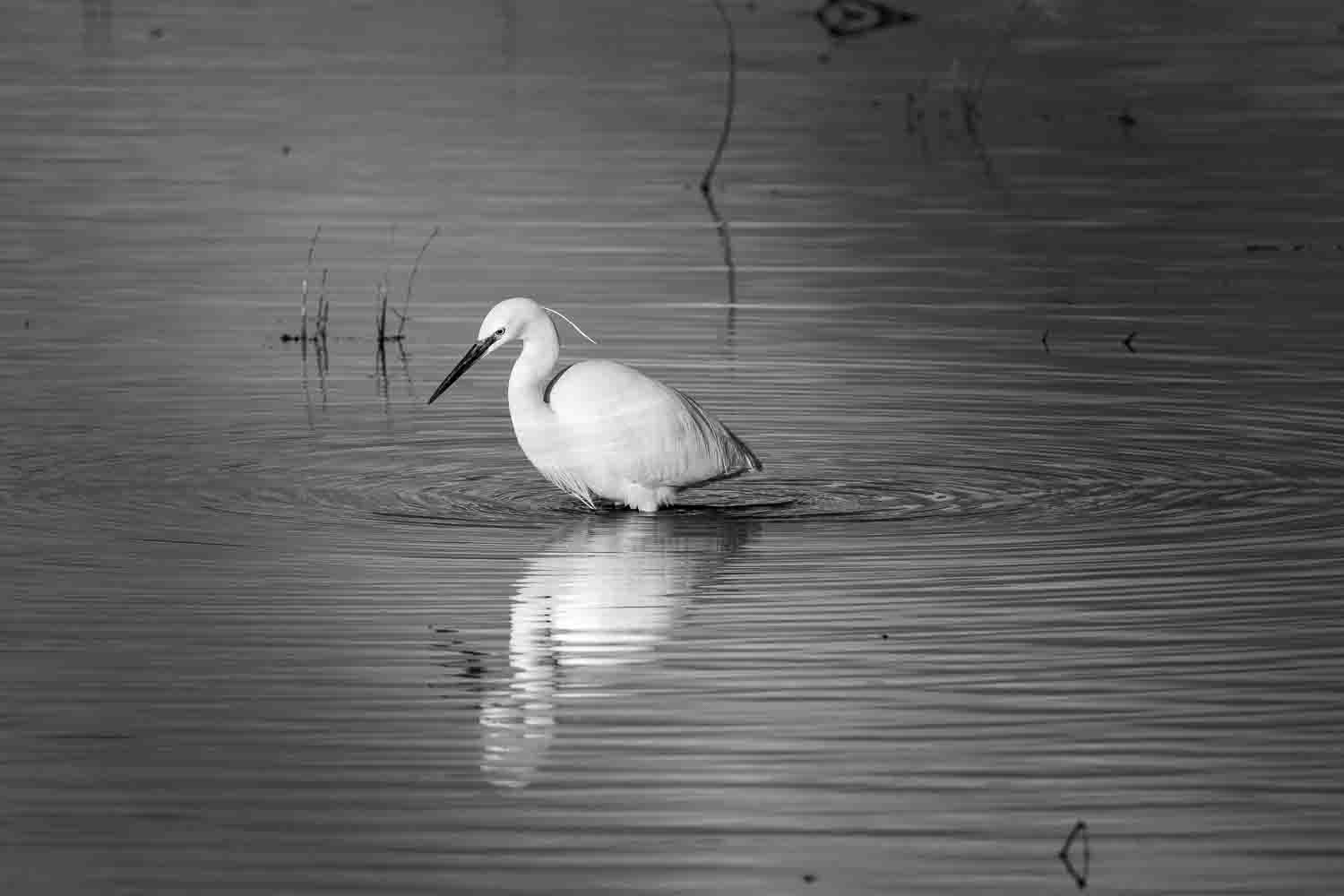
Above: my favourite capture of the morning. Camera settings, 1/3200th, F8, ISO 400, spot metered.
A minor rant about viewing angles
My only complaint about the pools around Lunt Meadows is that you can’t get low enough to the water. In an ideal world, you want to be at eye level when photographing wildlife. At the many pools around the reserve, you are raised slightly above water level, and so you are looking down slightly at your subjects. At the smaller pool, you can reduce the angle quite noticeably by crouching down against the mesh fence. However, it would be nice to have the opportunity to drop down to the water’s level.
Photobombed by a pair of Mallards
After the little egret had moved on, I turned my attention to one of our most loved dabbling ducks, the mallard. Often underappreciated at reserves like Lunt Meadows, as typically there are many rarer species to see and photograph.
For my first attempt at capturing their beauty, I observed a male paddling across the water. With his speed, he was leaving a wake behind him, which I thought would make for a beautiful, minimalistic photograph. As I lined up the composition, placing the mallard in the middle of the frame, I noticed a small group of mallards taking flight from the corner of my left eye. As luck would have it, I started capturing a burst of my initial subject, and the flying mallards flew across my frame.
There was zero time to adjust the composition, and luckily, I just about managed to capture the action! I was photobombed, and the result was unbelievable. Sometimes you’re in the right place at the right time, and this was my moment.

Continuing to observe behaviour, I captured a few more images of the male mallard as he went about his late-morning preening ritual.
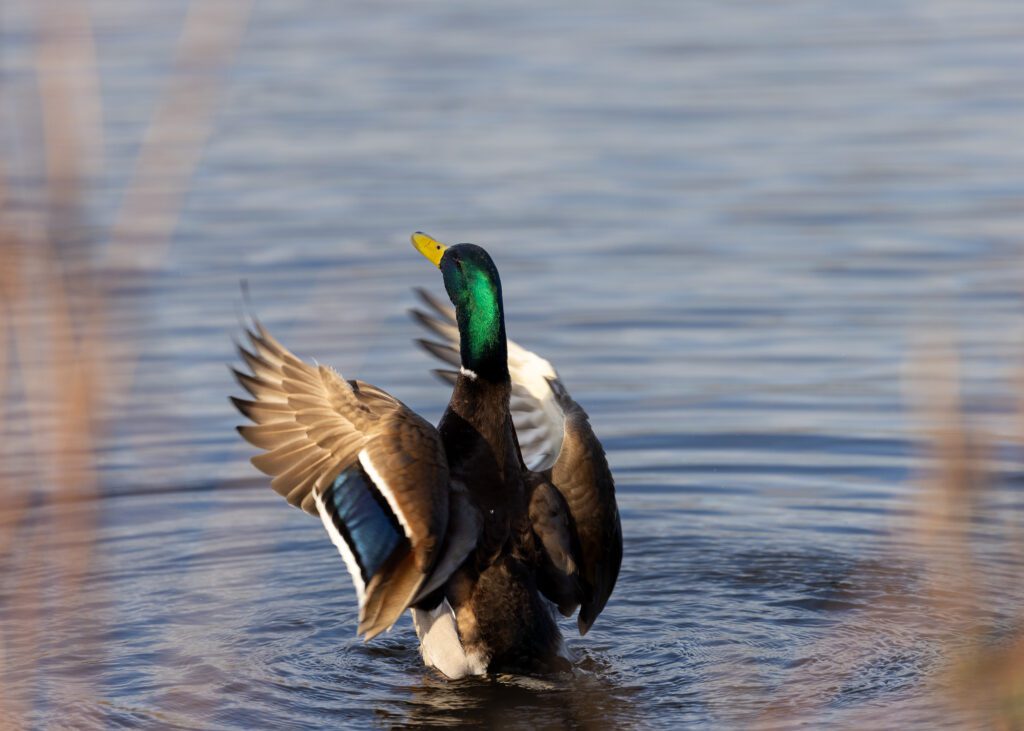
Above: the male mallard rising from the water and flapping his wings to dry off after a good preening session. A fast shutter speed was used to freeze the motion of its flapping wings. 1/1000th, F/5.6, ISO 640.
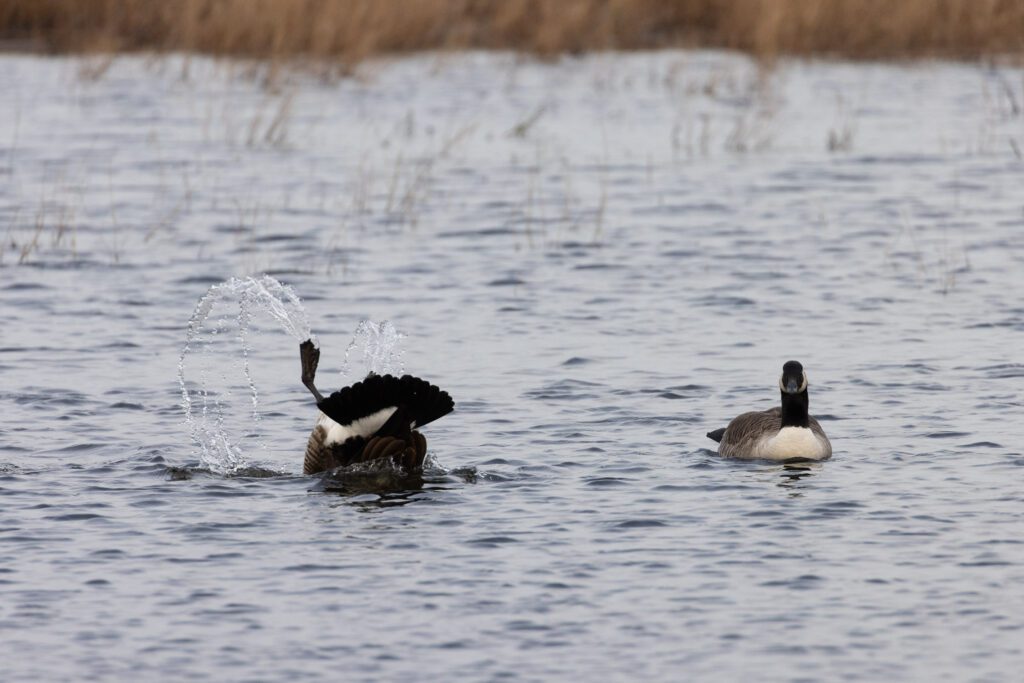
Below: the mallard vigorously shaking to displace water from its feathers after a prior dip underwater. Again, a fast shutter speed was used to capture the displacement of water caused by the shaking.
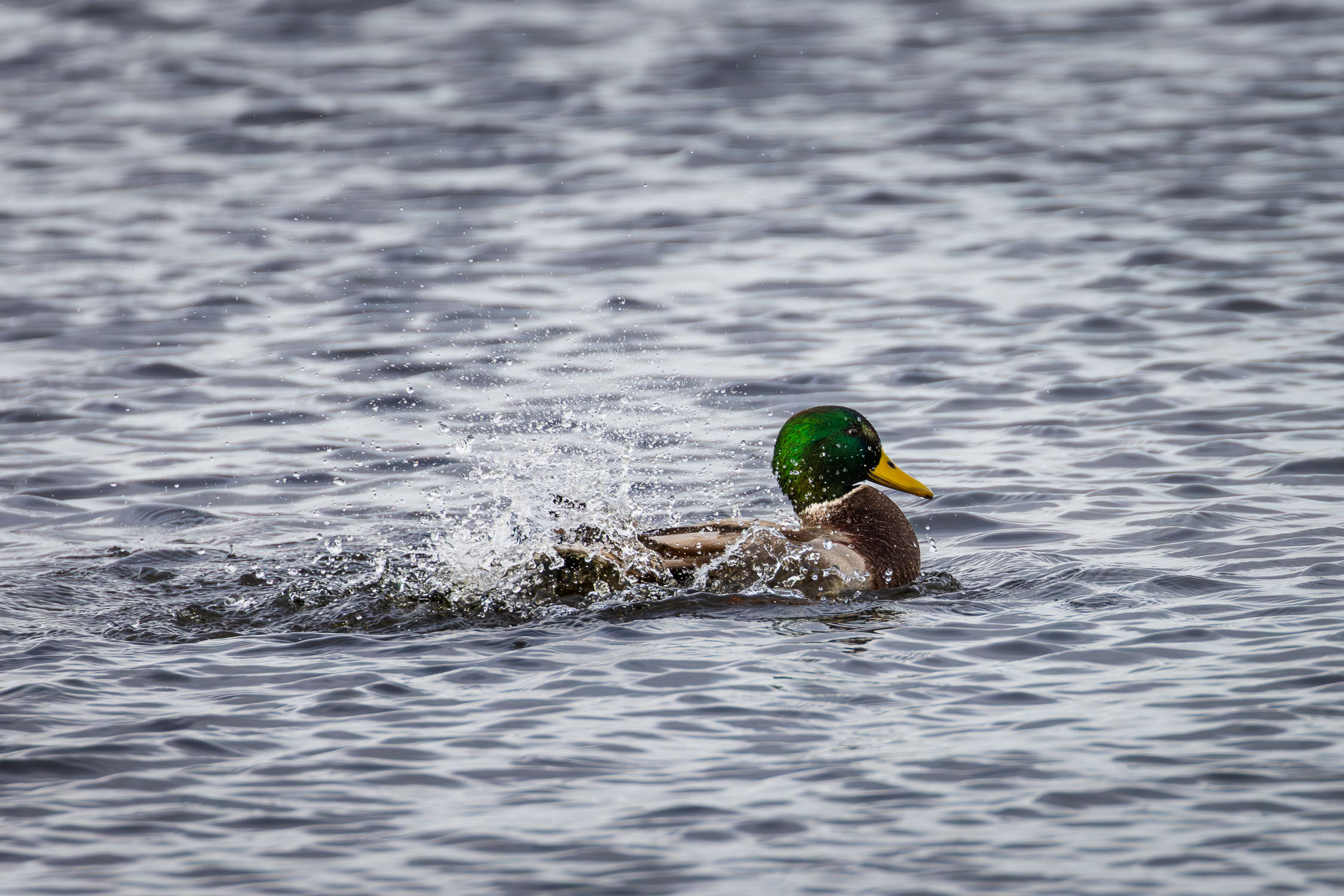
Above: Taken during a brief interlude in the morning light. 1/1250th, F/8, ISO 2000.
Ending the Morning with Minimalism
The final image of the morning was a pleasing, minimalistic style photograph of a mute swan surrounded by dark, rippled water. The main consideration for this image was to manage the highlights on the swan’s feathers. White feathers and direct light can be somewhat problematic when it comes to clipped highlights. It’s better to ensure you use the correct settings at the point of capture than to rely on correcting issues in post-processing software. When photographing scenes with high dynamic range (a significant contrast between lights and shadows), it pays to consider spot or highlight metering.
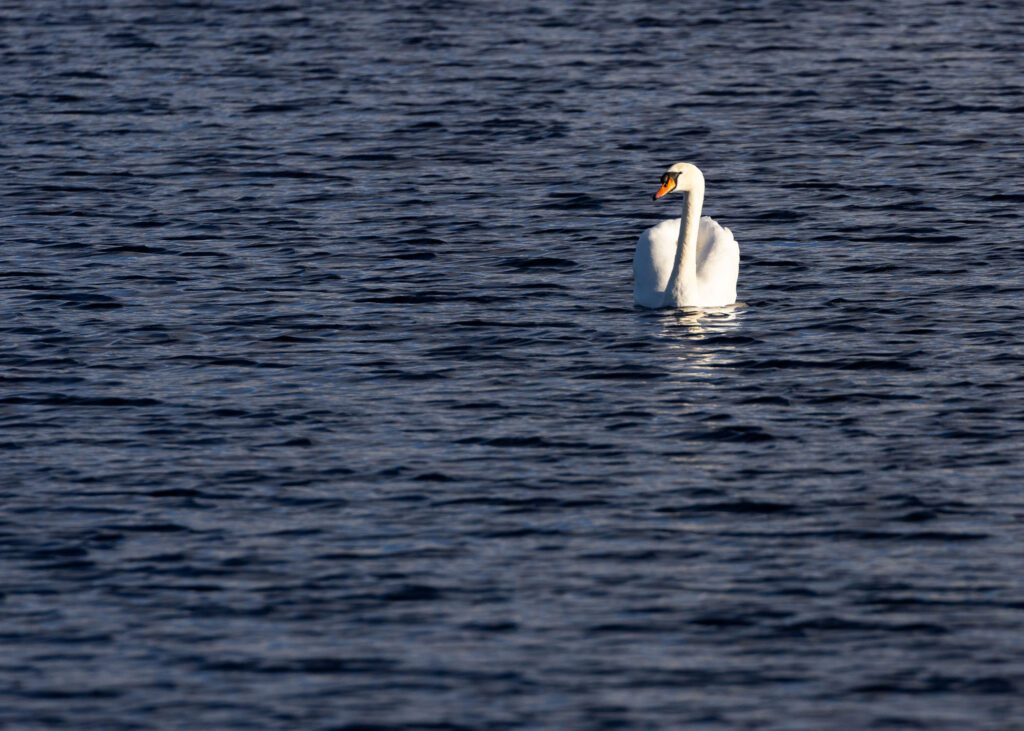
Above: mute swan minimalism. 1/2500th, F/5.6, ISO 400.
The “Sefton Shortie” – an Unfulfilled Capture
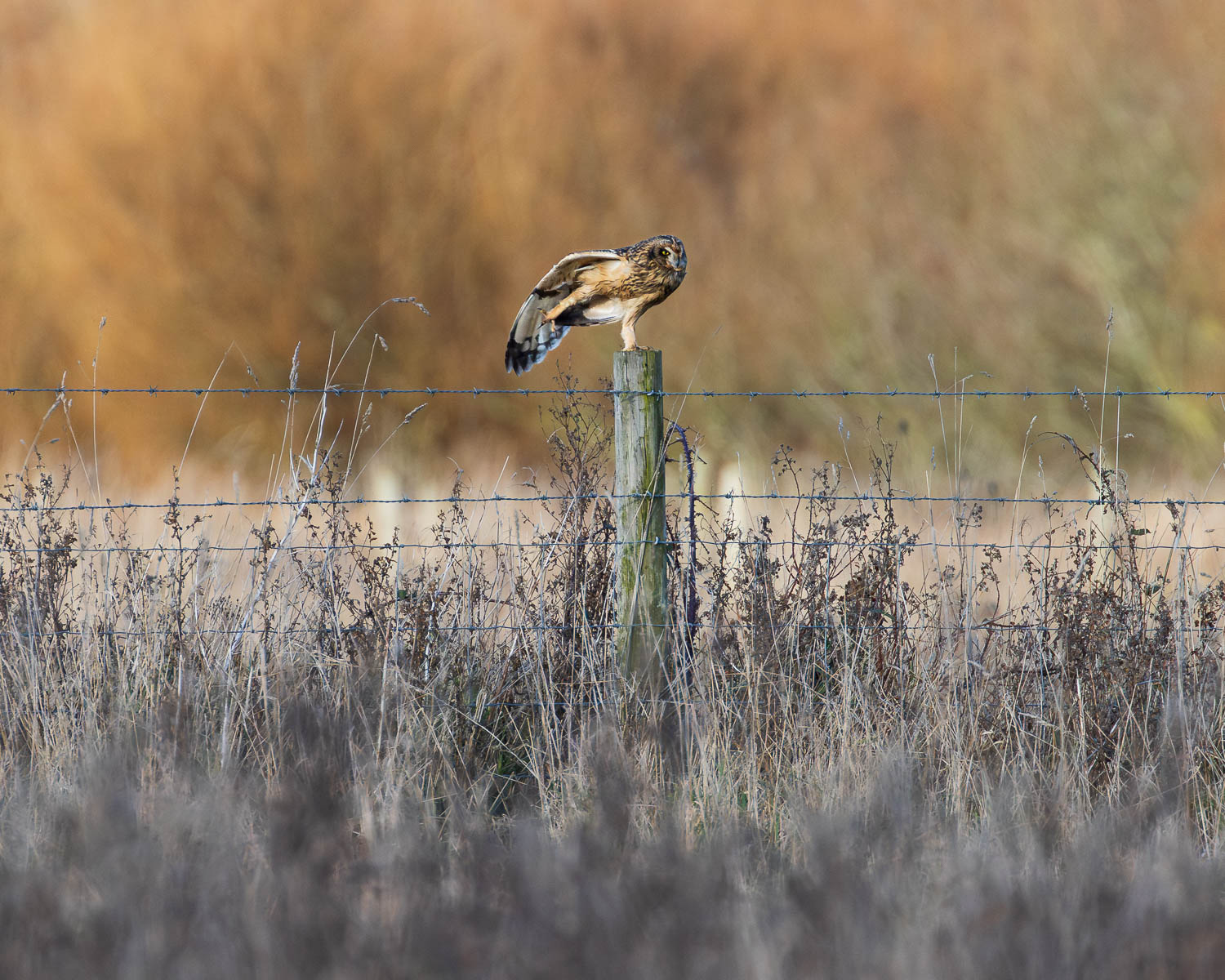
During this trip, I also managed to photograph a short-eared owl, albeit from quite a distance. I’m not going to lie, I wasn’t as excited by this capture as I thought I would be. Don’t get me wrong, seeing a short-eared owl for the first time was mindblowing. But, for some reason, I wasn’t as enthused about photographing a well-known owl at a popular nature reserve.
I thought the encounter over during the drive back home and came to a realisation. Wildlife photography is more to me than simply turning up and firing the shutter. It’s an intimate process of observation, fieldcraft, and forging a relationship with my subjects. By turning up and being essentially presented with a short-eared owl, I’d bypassed the whole process, leaving me feeling unfulfilled. I will capture another shortie behind the lens, but it will be a truly wild encounter, and one I will work hard for.
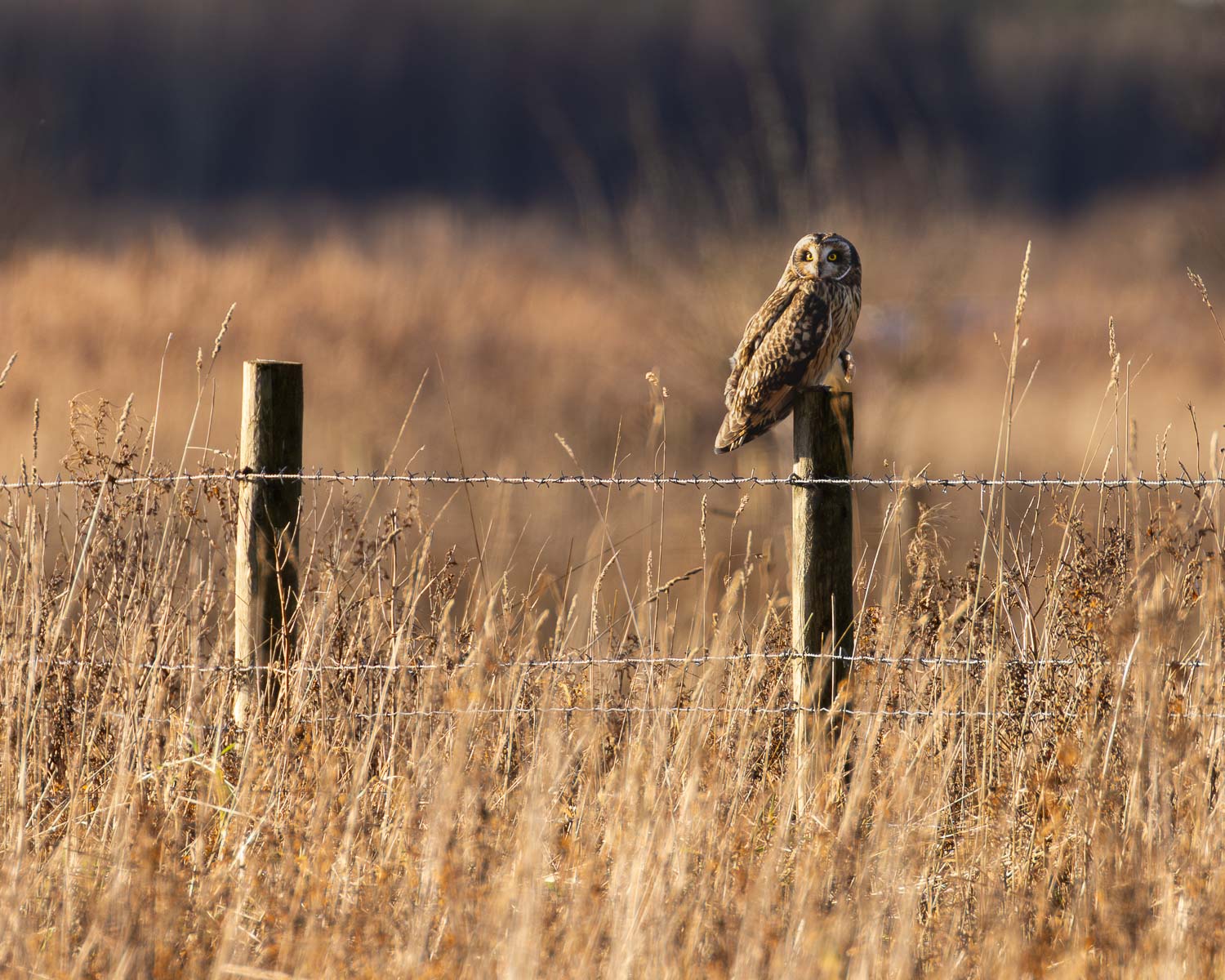
It goes without saying that this is my personal preference. I completely understand that not everyone has the time or accessibility to invest in fieldcraft. I will find another short-eared owl, and it will no doubt form part of a larger future personal project.
Top Tips for Wildlife Photography at Lunt Meadows
To wrap up this post, I thought it would be nice to end with a few top tips based on my own personal experience from my trips to Lunt Meadows.
- Learn the bird calls of regular visitors to Lunt Meadows. The more calls you are able to identify, the easier it will be to track down your subjects.
- Embrace the early morning or afternoon low light. Don’t be afraid to use higher ISO settings and consider giving the slow shutter speed panning technique a try.
- Keep your camera accessible. You never know what you might see around Lunt Meadows, and you might not get a second chance to capture the moment.
- Be aware of the direction of light and its impact on your subject(s).
- In dynamic light, continuously monitor your camera’s histogram to ensure you are using the correct exposure settings. Don’t rely on post-processing to save your images.
- Keep an eye on weather forecasts. Captivating images can be captured in all weathers. Think about weather conditions which may complement your subject(s). Examples: mist, morning frost, rain, gusty winds.
- Use a focal length of 400mm or more. Most of the time, your subjects will be quite a distance away, and so you may struggle with a shorter focal length.
- Chat with locals and other wildlife photographers. Most of the locals around Lunt Meadows are photographers or birders themselves and fountains of knowledge.
- Most important tip: pack a flask of tea. Odds are you’re in for a long but enjoyable trip. Treat yourself to a nice brew at one of the many hides and viewing screens around the reserve.
Useful Links for Further Information about Lunt Meadows
Lunt Meadows Nature Reserve is managed and run by the amazing Lancashire Wildlife Trust. You can learn more about the reserve by visiting Lancashire Wildlife Trust’s website via the link below.
https://www.lancswt.org.uk/nature-reserves/lunt-meadows
A small handful of photographs from my recent trip to Lunt Meadows can be found in my gallery. If you enjoyed reading, please consider visiting my seasonal galleries for a mix of landscape and nature photographs captured around the north west of England.
Bonus Photographs that Didn’t Make the Cut