
On Tuesday morning, I was rudely woken by an early alarm. After a brief battle of mind and body, I reminded myself why I was up – a spot of ghost hunting. Yes, that’s right, another trip to see a beloved local Barn Owl. I’ve become obsessed with spending time with them lately. I’ve always had a soft spot for them, but this year it’s stronger than ever. Even after all these years, I still get goosebumps every time I see a quartering Barn Owl. They’re angelic, yet unbelievably talented hunters – masters of their craft without doubt. Despite conditions looking perfect on paper, it turned out to be one of those days that leave you beaten and questioning your life choices. Okay, a slight exaggeration, but it was a firm reminder that nature does what it wants, when it wants, and no amount of preparation or gear will change that.
Perfect Conditions for Barn Owl Activity…In Theory
Tuesday morning looked prime for Barn Owl activity. Why, I hear you ask? Barn Owl activity is heavily influenced by weather. They are impeccable hunters, but with one major flaw: they lack waterproof feathers. This means that during sustained periods of wet weather, they’re vulnerable to starvation. Winter is a challenging time for wildlife, especially for owls, and this winter has been incredibly wet to say the least.
When planning a trip to photograph Barn Owls, the first thing I do is check the weather forecast. I’m looking for two things – low wind speeds and no rain. The forecast for Monday, 16th February, was an immediate write-off – borderline storm conditions with strong gusty winds and heavy bursts of sporadic rain – nightmare conditions for owls. However, the following day (Tuesday, 17th February) was a complete contrast. The storm had passed, the wind speed was much lower, and a near cloudless morning was expected. In theory, the best time to spot Barn Owls is the morning after adverse weather – the calm after the storm.
With that in mind, I headed out early on Tuesday morning, excited and ready to reconnect with a local ghost.
Inside my Backpack – Lightweight Essentials for Concealment
Travelling by bicycle means I have to carefully consider the gear I pack without compromising on concealment. Concealment plays a huge role in my wildlife photography, allowing me to observe wildlife respectfully by blending in with the environment. By seamlessly becoming a part of the environment, you’re more likely to capture raw natural behaviour.
When photographing Barn Owls, I generally travel light, and each item I bring has a valuable purpose. Here’s what I packed for the morning: a lightweight setup focused entirely on concealment and minimal disturbance.
- Camouflage one-way netting. One-way netting is a superb option for concealment, offering visibility without compromising on camouflage. The colour choice I pack depends on the environment I will be working in – leafy greens for fields and Realtree for woodlands.
- Scrim nets. I never leave home without them. They’re additional lightweight concealment options that I can quickly wrap around my camera equipment.
- Spring clamps. I use a couple of spring clamps to fix camo netting to the end of my lens hood and the bottom leg of my camera tripod, effectively creating a makeshift hide that I can sit under.
- 3D camouflage poncho. I don’t like wearing camouflage clothing whilst en route to my locations (especially if I’m cycling) as I often feel it draws unnecessary attention.
- 3D camouflage balaclava.
- 3D camouflage gloves.
- Camera tripod.
- Camera body. Canon EOS R5.
- Camera lens. Canon EF 100-400mm f4.5-5.6L IS II USM.
- Lens extender. Canon EF 1.4x extender III.
- Contigo Vacuum mug 750ml. Filled with tea, of course – an absolute essential for those cold mornings out in the field.
Becoming One With The Landscape
After a brief but chilly cycle, I arrived at my location just before 6 AM. It was still dark, but signs of the Blue Hour were beginning to show. Wasting no time, I set about quietly establishing my camera equipment and concealment. Being a regular spot for me, I had this process down to a T.
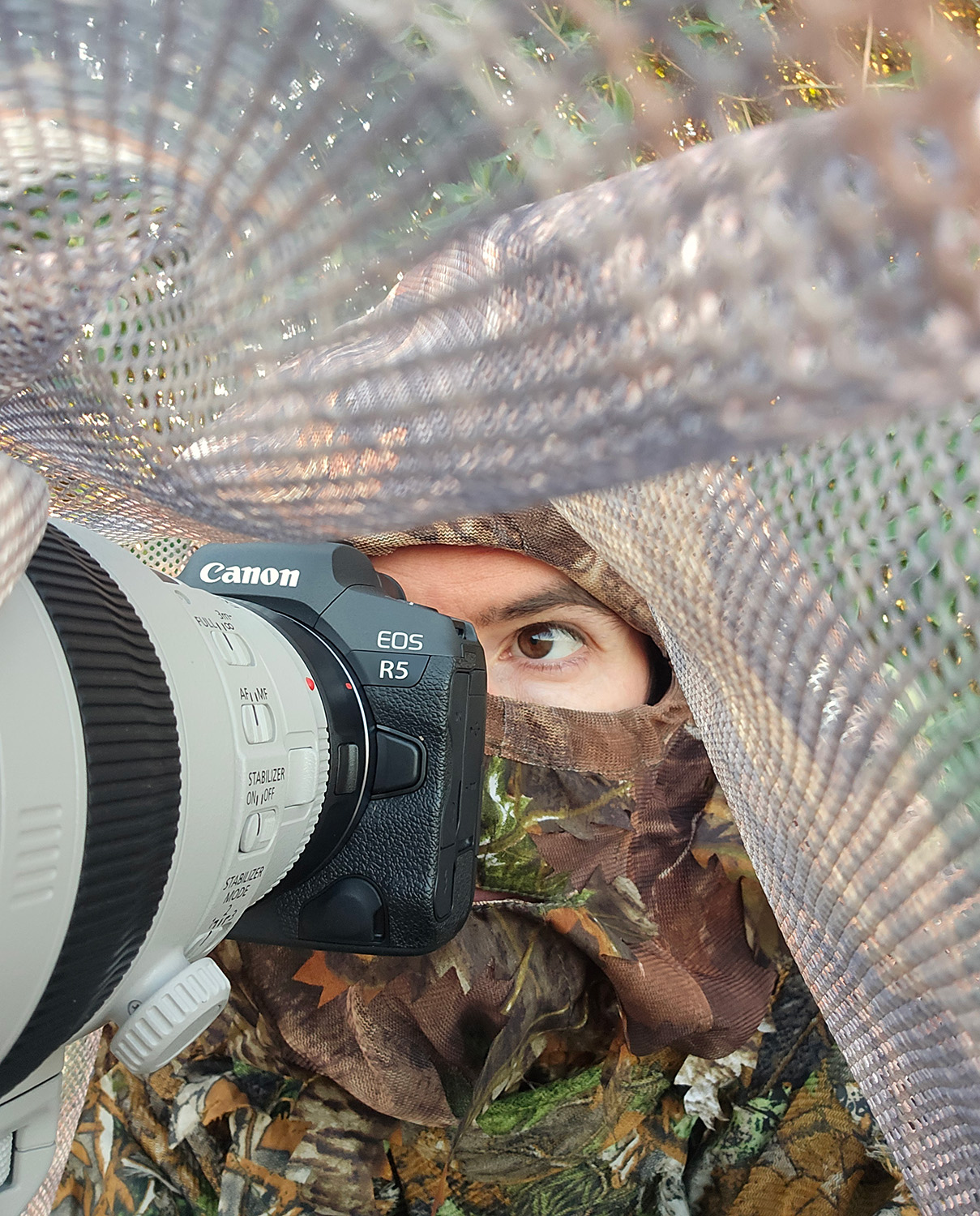
My setup for Barn Owls is straightforward and respectful to both the landscape and wildlife. I will never trample across fields to get a closer view. Instead, I established myself in a natural gap within a hedgerow which runs along the perimeter of the field, some 50m away from the hunting ground. Once my camera is set up and on the tripod, I drape a suitable camouflage one-way net over my gear and create a small hide. I then slip on my 3D camouflage clothing and disappear under my hide. Once under the hide, I will not move, nor make a sound. I always make sure I have everything I need to hand to avoid disturbance later on.
Happy with the setup, I hunkered down and waited for the magic hour to arrive – that golden window either side of sunrise, and the perfect time for spotting ghosts.
Barn Owl No-show, Stonechat Consolation Prize
As time trickled by under my hide, a male Tawny called out from a cluster of trees somewhere behind me – it’s always a pleasure to hear the iconic call of a Tawny owl. Slowly but surely, light levels began to increase as the Blue Hour transitioned to the Golden Hour. With the increase in light came the beautiful symphony of early morning bird calls. Song Thrushes, Robins, Blue Tits, Long-tailed, Pink-footed Geese, Meadow Pipits, the hedgerows and fields were teeming with life.
Sunrise arrived, announcing its presence by draping the landscape in gorgeous shades of gold – something I’ve missed dearly throughout the drab winter this year. Anticipation was high, but I couldn’t shake the feeling that the morning would be a no-show.
Behind me, the sun lifted above the horizon, its warm rays finally reaching my back. I’ve never been more thankful to feel the warmth of the sun; my fingers were like blocks of ice – numb after standing still for so long. The pain was only made worse by the fact that the Barn Owl hadn’t shown yet. In the near distance, I noticed a welcome distraction – a couple of beautiful Stonechats flitting amongst the long grasses. I watched them closely through my lens for a few minutes when an opportunity presented itself. The female had taken a perch on a tall grass stem directly in front of me. Not wanting to miss the opportunity, I quickly adjusted my settings and captured a single frame of the intimate moment. Little did I know at the time that this would be the consolation prize of the morning.
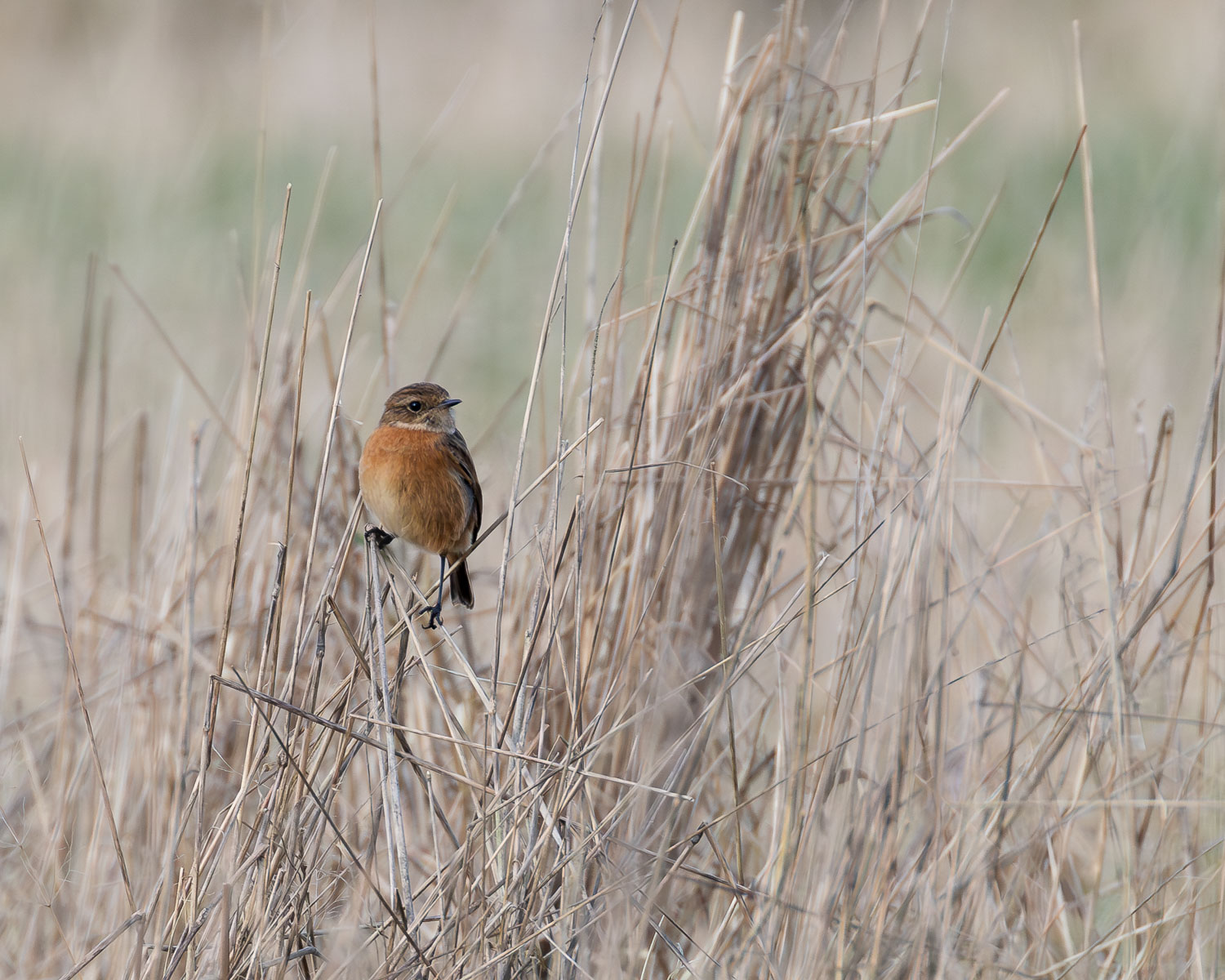
I honestly love opportunities like this. They’re a great reminder that if you’re respectful, patient, and considerate of your surroundings, nature will come to you.
Nothing in Wildlife Photography is Guaranteed
Before long, the golden window had closed. It was 9 AM, and I’d had no sighting of the Barn Owl. I’m not going to lie, it was tough. It always is, but that’s the reality of wildlife photography; nothing is ever guaranteed. This is what makes the successful encounters so much more valuable. They’re born through hard work, respect, persistence, and a willingness to improve.
In this case, the weather forecast was perfect – the calm after the storm – timing doesn’t get any better. My fieldcraft was on point, I was well concealed, and I remained silent throughout the entire morning. It’s entirely possible the Barn Owl was hunting on a known alternative patch. Their territories can extend for a couple of kilometres, and so sometimes it can truly be a case of being in the right place at the right time. The main takeaway from this post is don’t beat yourself up. For every successful encounter I have, I sometimes go two or three trips without a single sighting. It’s part of the journey and something to embrace as a wildlife photographer. Dust yourself off, keep your standards high and go again; that magical moment is closer than you think.
Have you ever had a no‑show of your own? Let me know how you pushed through it in the comments.
Read my New Guide: How to Ethically Photograph Barn Owls
If this post has inspired you, and you’d love to find out how you too can ethically photograph barn owls, my new in-depth barn owl photography guide has everything you need. Explore advanced fieldcraft tips, technical settings, and composition, with emphasis on patience and respect.
Spring is on the Horizon!
It’s an exciting time of year as we begin the transition towards spring. I’ll be practically living outdoors over the coming months, enjoying sensory overload as nature awakens from its wintry slumber. Keep an eye out for new weekly Field Notes as I enjoy life through the lens during one of the most anticipated times of year for landscape and wildlife photography.