
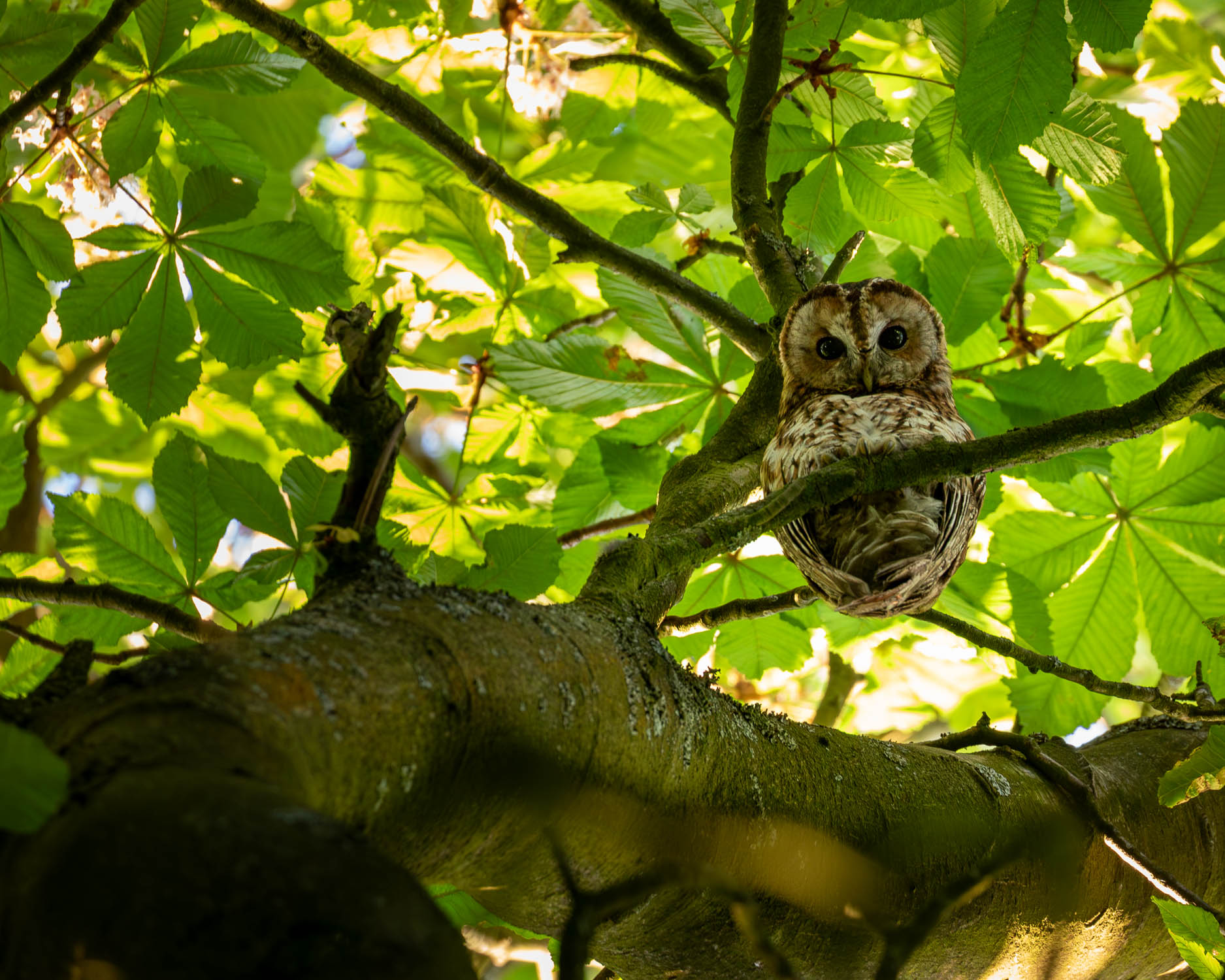
This Field Note documents the early stages of a fieldcraft‑based journey towards photographing a wild tawny owl in a local ancient woodland.
Tawny owls. Masters of camouflage, and a real treat to photograph if you’re lucky enough to find one. Living in the countryside, I’m no stranger to the iconic calls of both male and female tawnies: “Ke-wick” and “Twooo”. I often take my dog for a walk after dark just to hear their chatter breaking the silence in the surrounding woodlands.
In the past, I’ve found that the more hours I invest in searching, the less successful I am. It’s like tawnies specifically are the Achilles Heel of my wildlife photography. I’ve managed to capture quite a few tawnies on camera over the past few years, but I’d be lying if I said the photographs were planned. They were better described as moments of pure luck, being in the right place at the right time.
This week, I set out to begin the journey that changes that.
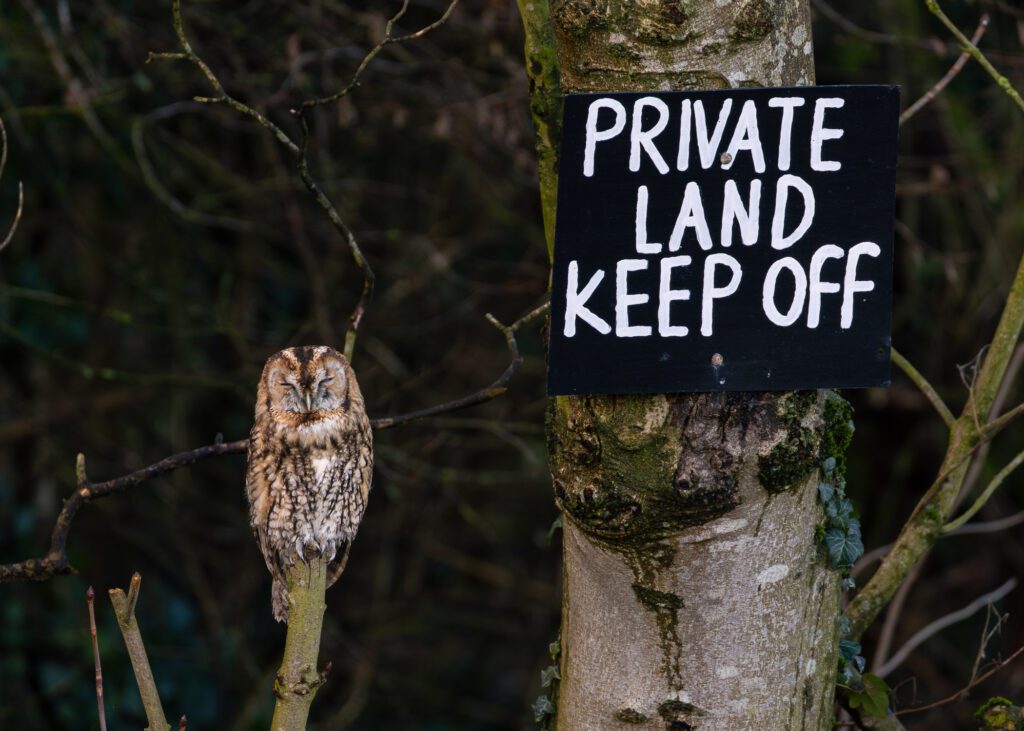
Scouting Ancient Woodlands for Tawnies
Much like us wildlife and landscape photographers, tawny owls are naturally drawn to ancient woodlands decorated with mature trees. However, thanks to their mottled brown feathers, they blend in seamlessly with the branches and foliage, making them unbelievably difficult to locate.
Their tree of choice tends to be gnarly old oaks, but you can also find them roosting in other deciduous trees such as ash and beech. Fortunately, I’m only a stone’s throw away from a couple of productive ancient woodlands, the perfect location to start my search.
Before heading out, I already had a small piece of intel that helped guide my decision-making. On those late-evening dog walks I mentioned earlier, I mentally made a note of rough locations I’d heard tawny owl chatter throughout the night. Knowing where they’re active during the night is invaluable information; it gave me a solid starting point by reducing the size of my search area.
Wildlife Code of Conduct
Before I continue this Field Note, if you’re reading this and feel inspired to head out in search of a tawny owl to photograph, please, please, please, remember to observe the Wildlife Code of Conduct.
Tawny owls are protected by the Wildlife and Countryside Act 1981, and due to a heartbreaking decline in their population, they’re on the amber conservation list. With this in mind, they deserve space and our full respect, especially during the breeding season.
Keep noise to a minimum, avoid approaching too closely, and never disturb a roosting owl.
Fieldcraft: searching for signs of activity
On entering the woodland, it’s all about observations; I’m not focused on photography, and my camera very rarely leaves my bag. At this point, it’s all about building up a picture with my own two eyes, and a camera will only distract me from noticing the more subtle signs of activity.
Looking for hollows in trees
The first thing I started to look for was hollows in old trees, especially gnarly-looking oaks that tawnies seem to favour. I’ve had a dream for as long as I can remember of wanting to photograph a tawny perched on a hollow entrance, so these deep battle scars always catch my attention. To check them safely, I used binoculars to keep a respectful distance, usually around 40-50 metres where possible. Many of the oaks I scouted were inaccessible, sat on the far side of a brook, which made it easier to maintain a safe distance without risking disturbance.
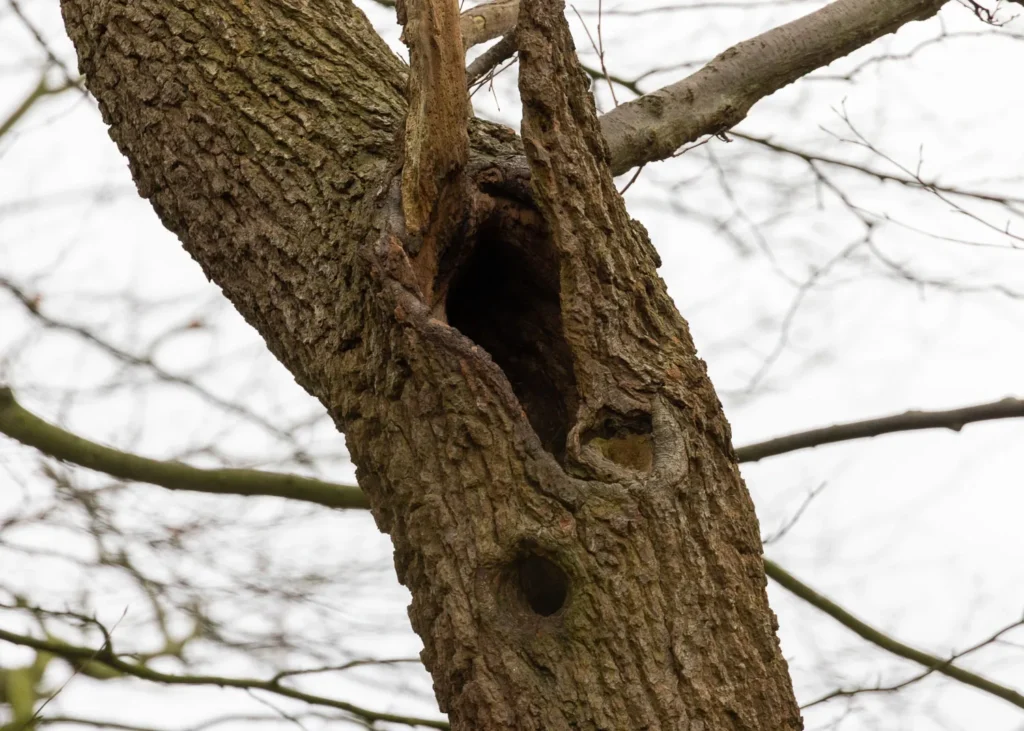
I noted down five hollows as potential areas of interest and took a few record shots on my phone. Most of the hollows appeared to have formed where large branches had fallen from the trees, most likely from previous storms. They were certainly wide enough to house a tawny, but without knowing their depth, it wasn’t possible to tell if they were suitable roosts. Promising leads nonetheless.
Pellets: the biggest clue of activity
Happy with the mental map of hollows, I turned my attention to the forest floor and began the search for the biggest telltale sign of activity: owl pellets. These indigestible clumps of fur and bones are the discarded remains of prey. It sounds grim, but they’re a gold mine of information. Where they’re found often indicates either a roosting spot or a favourite perch, somewhere in the branches above.
As I worked my way back towards the entrance of the woods, a small patch of grey caught my eye. It clearly didn’t belong among the rustic colours of the forest floor. Owl pellets.
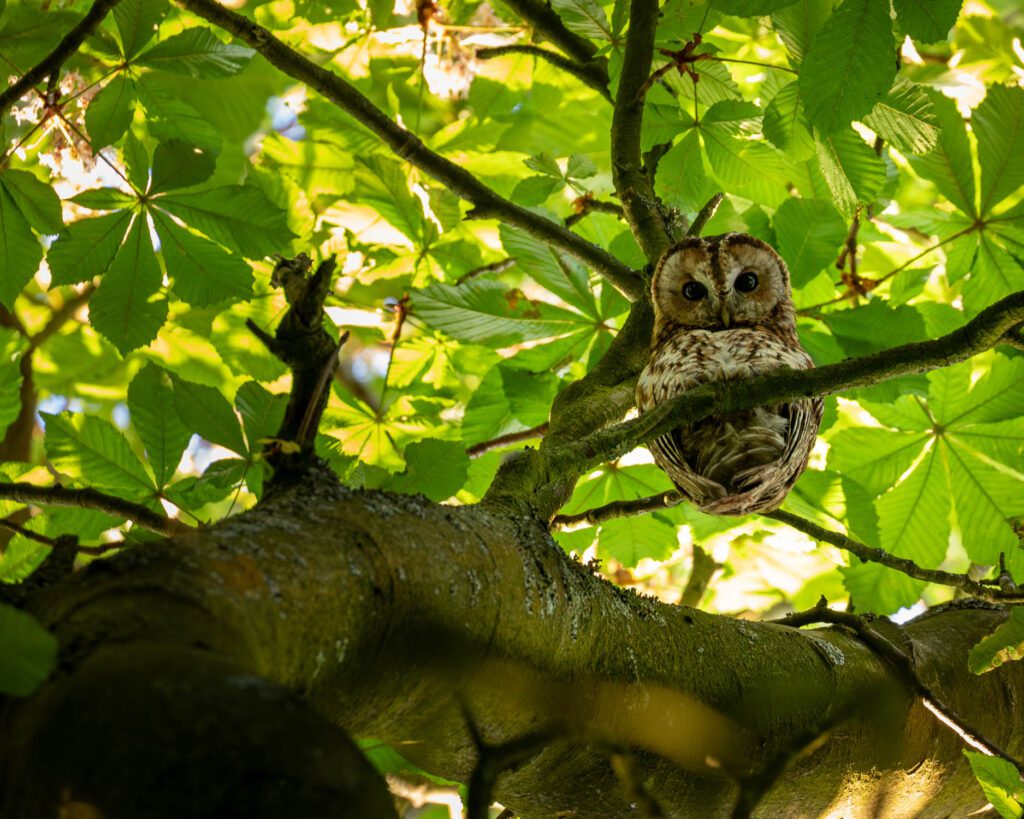
Funnily enough, the pellets were in almost the same spot where I unintentionally came across a female tawny last spring (see photo below). I knew it wasn’t a nest spot, as it was too close to the woodland edge and too exposed to the daytime noise of dog walkers and cars driving along the country lane. It was more likely to be a favourite perch.
Either way, it was another piece of the puzzle.
An Ongoing Journey
I left the woodland happy with the intel I’d gathered, and this is where the search pauses for now.
As we move into breeding season, the last thing I want to do is disturb tawnies during such a sensitive time of year. As much as I’d like to uncover more signs of activity, their welfare comes first. Knowing how territorial tawnies are, if they are indeed roosting in the woodland, they’ll likely remain there all year round, leaving plenty of time for photography later on in the season.
Every sign I uncover is a step closer towards that dream tawny owl photograph. The journey is far from over, and I’m in no rush to see it through.
Further Reading: Ethical Fieldcraft and Barn Owl Photography
If this Field Note has inspired you to explore the outdoors in search of owls, but you’re not quite sure where to start, my deep dive into photographing barn owls is the perfect next step. It covers ethical fieldcraft, recognising and understanding behaviour, identifying suitable environments, camera gear, and creative approaches to composition – principles that apply to tawnies just as much as they do barn owls.