
Photographing a barn owl for the first time is a moment you will never forget. I will always remember my first encounter with a male that turned out to be one of the most prolific hunters I’ve ever laid eyes on. The opportunity came after weeks of patience and fieldcraft, enduring the onslaught of everything winter had to throw at me. Seeing that ghostly white figure gliding over a frosty meadow was all the warmth I needed.
Since then, I’ve become infatuated with the beauty of barn owls, and I still get goosebumps at the sight of my local owls quartering at dawn and dusk. I’ve spent quite literally thousands of hours hidden along the edges of my local meadows, respectfully observing and photographing barn owls, familiarising myself with their unique behaviours and habits. All of that experience forms the backbone for this guide, giving you the knowledge I wish I had when I first started.
Welcome to my ethical guide to barn owl photography.
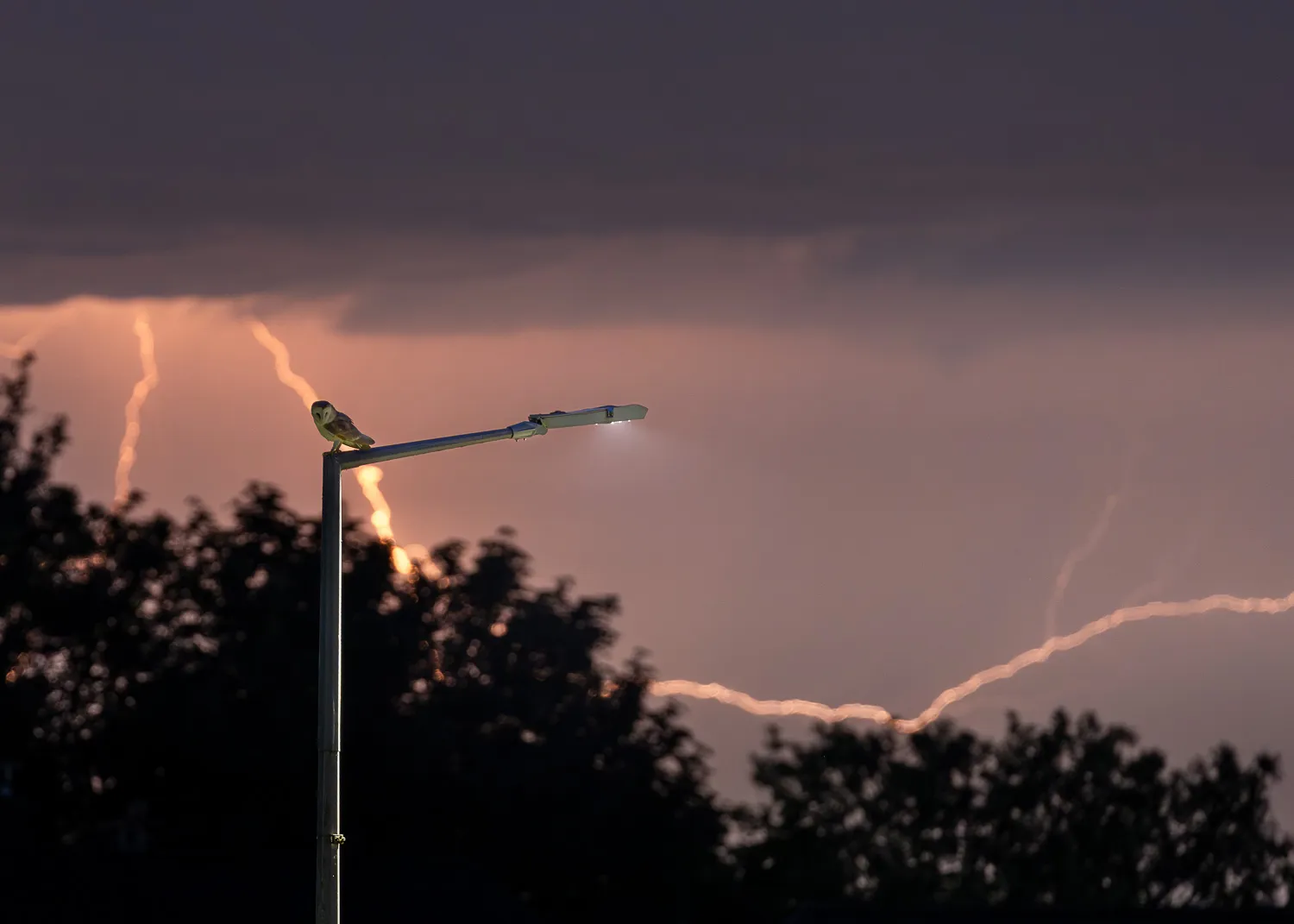
Barn owls are among the UK’s most protected and sensitive birds of prey, and every technique in this guide is built around prioritising their wellbeing first and the photograph second. I’ve covered everything from identification and preferred environment through to legal protections, fieldcraft, seasonal behaviour, camera settings, and composition. It’s a long and thorough read, so consider bookmarking it and working through it at your own pace.
- How to Identify Barn Owls (Tyto alba)
- Wildlife Code of Conduct
- Using Fieldcraft to Discover Signs of Barn Owl Activity
- Time of Day and Seasonal Impacts
- The Art of Concealment
- Recommended Camera Gear for Photographing Barn Owls
- Camera Settings for Typical Barn Owl Encounters
- How to Photograph Barn Owls Flying Towards You in Low Light
- Photographing Hovering Barn Owls
- How to Photograph Perched Barn Owls
- Storytelling and Composition
- Final Thoughts on Ethical Barn Owl Photography
- FAQs
How to Identify Barn Owls (Tyto alba)
Before you eagerly head out with your camera, it’s worth understanding what you’re actually looking for. By this, I mean the appearance of barn owls, their behaviour, and the physical signs of activity that they leave behind. There’s a reason they’re often called ‘ghosts’; they slip by gracefully without you even noticing.
The penny dropped for me as soon as I discovered where to look and when. Small details like this compound, and before you know it, you’ll recognise a productive hunting ground from a mile away.
What does a barn owl look like?
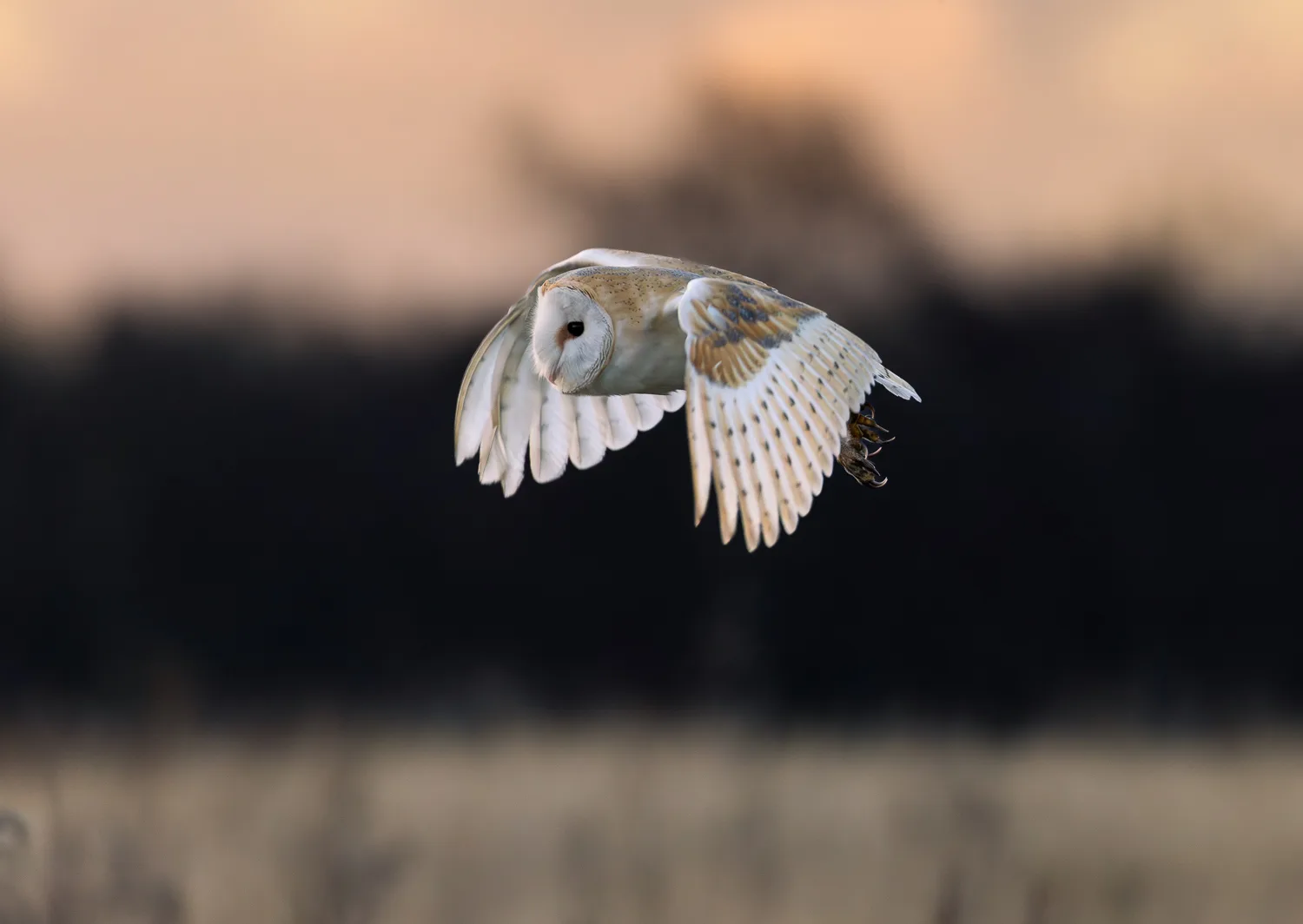
Despite being somewhat elusive, barn owls are instantly recognisable by their ghostly white underparts and heart-shaped facial disk, framed by beautiful buff and gold upperparts. The shape of their face is one of their most impressive evolutionary traits: it acts as a satellite dish, collecting sound and funnelling it directly to their ears.
If that weren’t enough, their dark eyes are finely tuned to detect even the slightest movement. Combine those keen senses of sight and sound with nearly silent flight, thanks to specialised feather structure, and it’s a terrible time to be a field vole.
One flaw in the barn owls’ otherwise perfect adaptations is their lack of waterproof feathers, leaving them vulnerable to the UK’s wet and miserable winters.
Do barn owls hoot?
Unlike the UK’s other three native owls, the barn owl doesn’t have a typical hoot. In fact, its call is nothing like that of the iconic tawny owl. Instead, barn owls produce a terrifying, drawn-out screech guaranteed to take you by surprise if you haven’t heard it before. Despite that, you’ll rarely actually hear one call. Barn owls aren’t especially vocal outside of the breeding season, and their near-silent flight means they can pass close by without you ever knowing they were there. If you’re fortunate enough to hear a screech, it’s usually a sign of territorial behaviour or communication between pairs.
Where can barn owls be found?
Barn owls are found in open landscapes where prey is abundant, and they’re naturally drawn to areas of land left to grow wild. If a field is heavily farmed or frequently cut, the odds are it’s not a suitable hunting ground for a barn owl. Areas to consider include rough grassland, meadow edges, field margins, marshes, and quiet farmland.
If you come across any of these hunting grounds in close proximity to old open barns, hollows in trees, or derelict buildings, there’s a good chance a ghost is living nearby.
What do barn owls hunt?
Field voles make up the bulk of a barn owl’s diet, though wood mice, shrews, small birds, and occasionally frogs are also taken.
Barn owls thrive in areas where prey is plentiful. When prey is scarce, they may travel longer distances to hunt (their home range can extend to around 3-5 km), and they may also become active at unusual times of day.
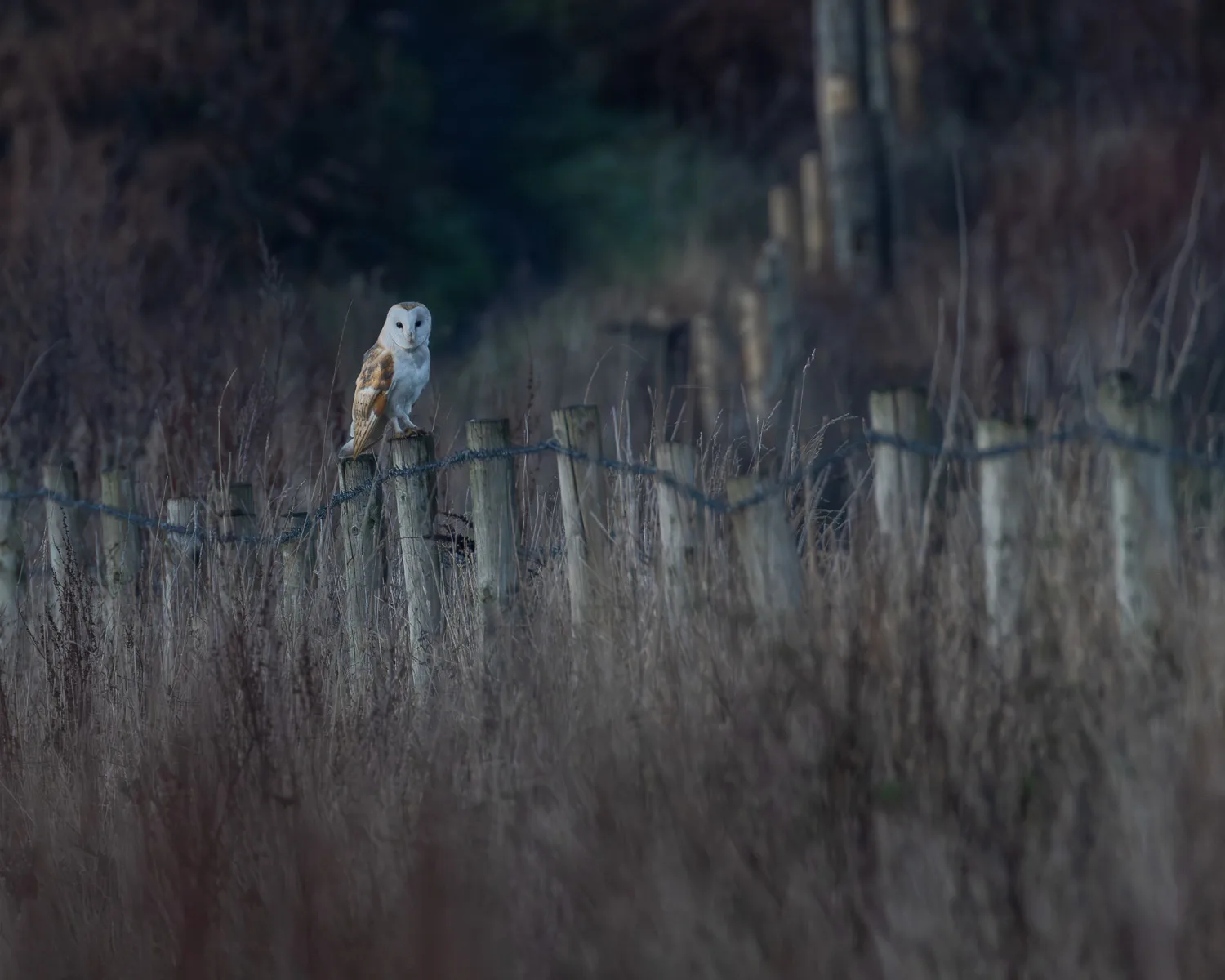
Throughout the winter months, it’s not unusual to see barn owls “lazy hunting” from perches such as fence posts. By sitting and waiting for signs of movement, they can conserve vital energy, a strategy that can mean the difference between surviving and succumbing to a harsh winter.
If you’d like to go deeper into barn owl ecology and the conservation work protecting them, the Barn Owl Trust is the best place to start. It’s an organisation close to my heart, and the work they do plays a real part in giving barn owls a fighting chance across the UK.
Wildlife Code of Conduct
Barn owls, like all wild birds in the UK, are protected under the Wildlife and Countryside Act 1981. This gives them the baseline legal protection afforded to almost every wild bird species. They’re highly sensitive to disturbance, and as wildlife photographers or observers, we need to act responsibly. No photograph is worth causing deliberate harm or stress to a wild animal, ever.
What legal protection do barn owls have?
Barn owls receive special protection under Schedule 1 of the Wildlife and Countryside Act 1981. It’s a criminal offence to intentionally or recklessly disturb a barn owl while it’s nesting, or to disturb its dependent young. Even if disturbance wasn’t your intention, if you were aware of the risk and went ahead regardless, you’re breaking the law.
If, for any reason, you think you are close to an active barn owl nesting site, the only ethical action is to carefully back off and leave the area. As wildlife photographers, it’s our duty to protect the welfare of our subjects.
Should you share barn owl locations?
Sharing locations of particular species is a controversial topic in wildlife photography. Personally, I will always side with nature and keep locations private. Is it gatekeeping? To an extent, yes. But I’ve seen firsthand what publicity can do to sensitive wildlife. Even well-intentioned photographers can add pressure to a site, especially during harsh winters and the breeding season.
When it comes to wild barn owls, my rule is simple: keep locations as vague as possible, and never reveal nest sites under any circumstances.
Respect the landscape and local farmland
Unless you have explicit permission from the landowner, don’t trespass. A barn owl’s home range typically overlaps with working farmland; the last thing you want to do is upset hard-working farmers by trampling crops. In my experience, I’ve found local farmers to be welcoming and approachable. If you introduce yourself and explain your intentions, most farmers won’t have an issue with you respectfully observing from their land. They’re also fountains of knowledge and will generally give you a helpful pointer in the right direction.
Whether you’re on public land or private land with permission, leave no trace. Don’t trample wildflowers, damage habitats, or alter the landscape for the sake of a photograph or a slightly closer vantage point. Always take all litter home with you and leave the area exactly as you found it.
Recognising signs of stress
It’s worth learning to recognise the signs of stress or pressure barn owls may show so that you can avoid disrupting their natural behaviour. If a quartering owl repeatedly looks towards you or abruptly alters its hunting pattern, it has seen you, and you’re either too close or too disruptive. Barn owls have exceptional hearing and are finely tuned to detect the slightest movement, so even the smallest motion is enough to draw the gaze of a hunting owl.
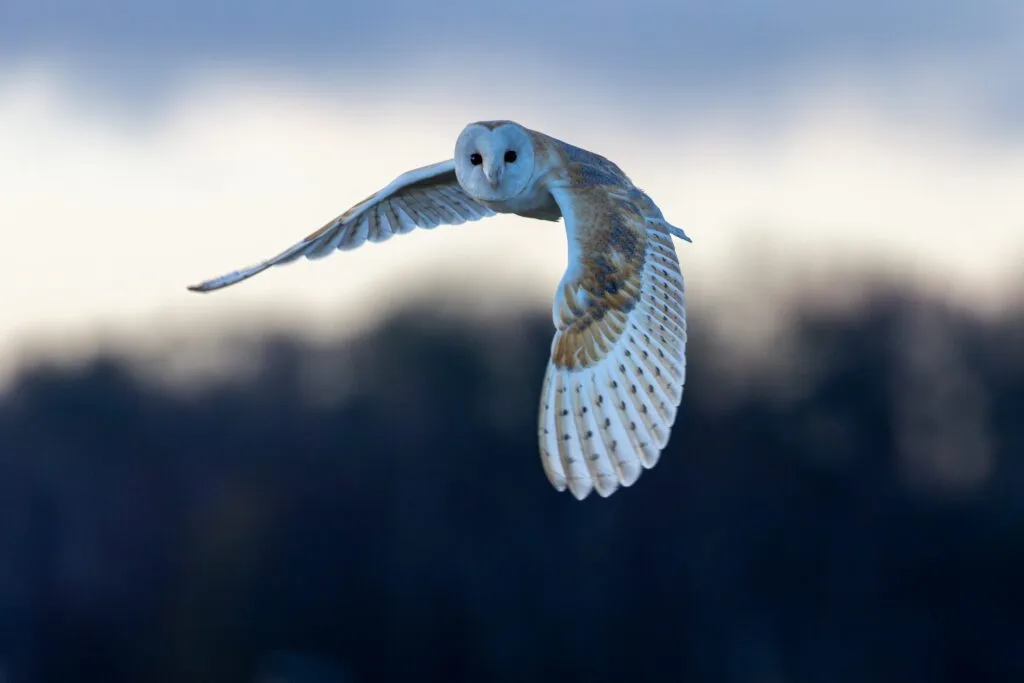
The best way to avoid causing stress is to slow right down and let the owl dictate the encounter. Don’t be tempted to track its every movement with your camera; wait for it to cross your path. The most emotive, natural-looking photographs will always come from relaxed subjects.
Keep it wild. No baiting and no playback
Barn owls are true masters of their craft; they rarely require our intervention. With that said, baiting is an extremely negligent practice that not only removes the truly “wild” aspect but potentially disrupts their natural behaviour.
Drawing barn owls closer through playback is also an unethical approach to observation, one that can put the owl at risk. At certain times of year, energy conservation is critical to their survival. The last thing you want to do is waste an owl’s limited reserves by encouraging it to respond to false calls.
Let encounters unfold naturally. The reward of seeing a wild barn owl is infinitely more precious when the moment is earned through patience and fieldcraft.
Using Fieldcraft to Discover Signs of Barn Owl Activity
There’s nothing more awe-inspiring than seeing a barn owl quartering over a field. Quartering is a hunting strategy used for impressive efficiency: a barn owl will fly low and slowly over rough grassland, covering the land in a methodical pattern as it listens for signs of prey. Owls routinely following the same hedgerow or margin are likely working a productive hunting line.
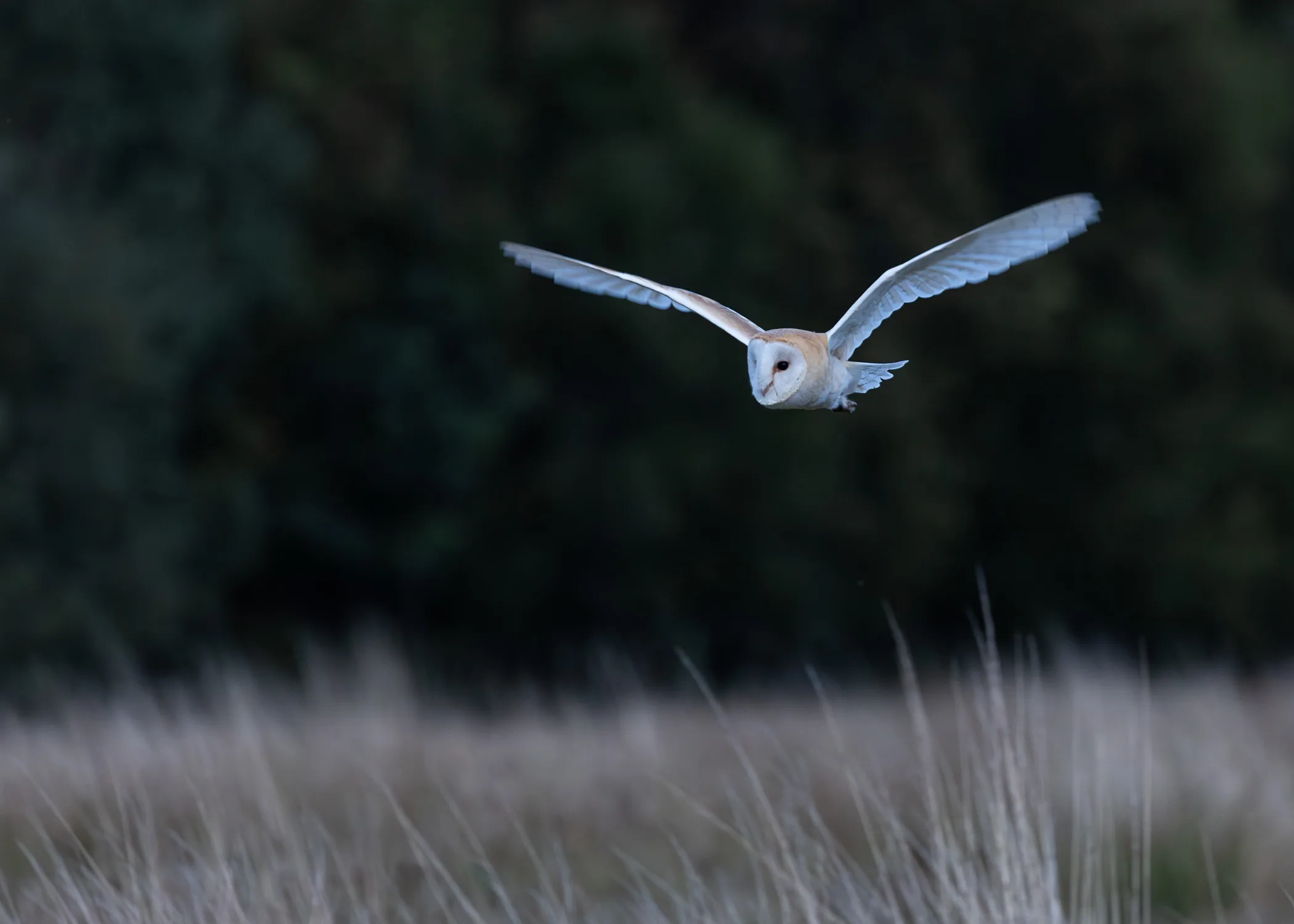
Understanding why owls choose those spots is where fieldcraft comes into play. The landscape always bears clues about what goes on, past and present. Telltale signs include pellets, whitewash, and hidden vole networks under the long grass. Learning how to look out for these signs is what separates a productive afternoon from a no-show.
How to Read a Landscape
Odds are, you’ve walked past ideal barn owl hunting grounds without ever realising it. Productive hunting grounds share a few key characteristics; they’re often rough and unkempt. The longer a piece of land has been left to grow wild, the better. Fields that are regularly cut, intensively grazed, or kept tidy will rarely support the precious ecosystems that barn owls rely on.
Rough grassland is quite possibly the strongest indicator of a good hunting habitat. Long, tussocky grass provides perfect cover for field voles, the barn owl’s preferred prey. Messy corners of farmland, overgrown verges, and patches of land left to grow wild are always worth a closer look. If you notice uneven ground and dense clumps of grass, those will likely form natural tunnels, the foundation for vole networks.
Field margins and boundary edges are also classic examples of productive hunting grounds. Barn owls can often be found quartering along dividing edges; look for ditches, fencelines, and hedgerows. These features often naturally concentrate prey, making them more attractive to hunting owls. Fields divided by fencelines also provide invaluable perches for barn owls, allowing them to “lazy hunt” to conserve energy.
None of this matters if the surrounding area is heavily disturbed. Barn owls prefer the tranquillity of open countryside settings, where prey can thrive undisturbed. Locations with heavy footfall or near busy roads or train tracks are less likely to be productive. Anywhere with regular foot traffic or heavy management rarely holds enough prey to sustain a barn owl’s nightly needs.
Once you know how to identify the features of a good hunting ground, the next step is looking for evidence that an owl has actually been there, usually in the form of pellets and droppings.
Impacts of prey density on barn owl activity
Field voles make up the largest share of a barn owl’s diet, so it makes sense that prey density has a noticeable impact on their hunting activity. Field vole populations fluctuate in a series of natural peaks and troughs roughly every 4 years. During a peak, voles are abundant, and barn owls will generally show shorter, more focused hunting patterns. They are also more likely to return to the same reliable grounds night after night because they know the areas are highly productive.
During a trough, field vole numbers fall to their lowest point, and barn owls will show this through their behaviour. Their hunting patterns become less predictable as they enter survival mode, often travelling much further afield in search of food. Outside of breeding season, this distance can be as great as three or four kilometres from their nest site, which is a huge distance for a bird that can’t afford to waste energy.
Understanding how barn owls react to prey density is one of the most important elements of fieldcraft. This alone will explain why certain fields, despite looking perfect on paper, aren’t productive. It also provides context as to why you may see a barn owl hunting in a field one day but not the next.
Once you’ve found a field you think is a suitable hunting ground, try this: sit down somewhere nearby, preferably concealed, get comfortable, and simply listen. Listen for rustling in the grass and the distinct squeak of short-tailed field voles; in a productive field, it won’t be long before you hear them. How often you hear this can give a rough indication of how suitable the field is as a productive hunting ground.
What is a barn owl pellet?
Coming across a discarded pellet is one of the most reliable signs that a barn owl is active in the area. Pellets are the compacted remains of bones, fur, and teeth that an owl can’t digest. After feeding, owls will regurgitate this material as a pellet. They’ll normally do this from a favourite perch or within their nest. As far as fieldcraft is concerned, if pellets are there, an owl has been there too.
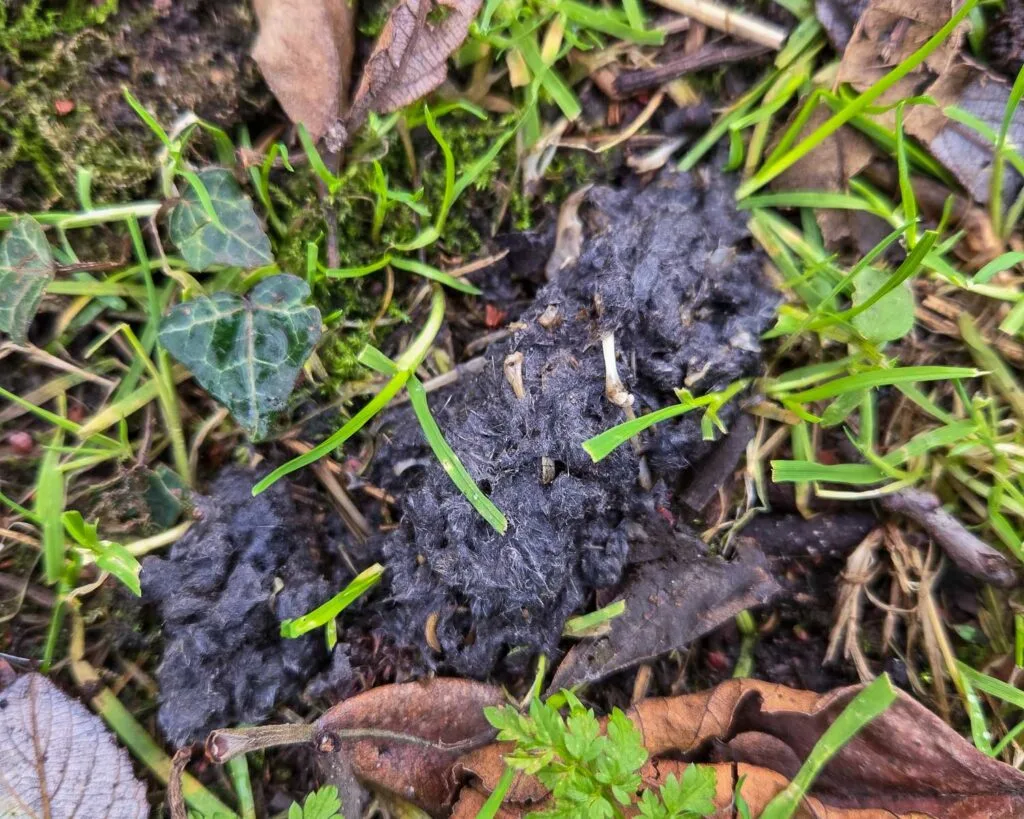
Fresh barn owl pellets are typically about the size of a thumb and black, turning grey with age. Owls usually eject one or two pellets each night, meaning they can start to stack up quite quickly. Surprisingly, one single pellet can contain the remains of several small mammals.
If you’re lucky enough to find a pellet and curious to know what a barn owl has eaten, you can dissect the pellet and use jawbones to identify the remains. Collecting pellets is legal in the UK, provided it’s done ethically. You must not take pellets from nest sites (broken-up pellets are used as nesting material), and you must never disturb an owl to retrieve a discarded pellet. When in doubt, refer to best-practice guidance from credible organisations such as the Barn Owl Trust or the Wildlife Trusts.
Barn owl droppings
Talking about droppings doesn’t sound as exciting as pellets, but knowing what barn owl droppings look like is genuinely useful fieldcraft knowledge. Fresh droppings typically appear as white, wet splashes beneath regular perches.
You’ll generally find droppings in the same places you find pellets: beneath or on fence posts, low branches, and other favoured lookout points. Finding both together is about as strong an indicator as you can get short of seeing the barn owl itself; you can be fairly confident you’ve found an active site.
Droppings can help you gauge how recently a barn owl has visited a perch. Fresh deposits have a wet, glossy appearance before drying over the course of a few hours. Similar to pellets, avoid getting too close to nesting sites. This guide is only intended to help you ethically photograph barn owls hunting in open fields from safe, considerate distances.
Look for kestrels as they often hunt for the same prey
More often than not, you’ll find that where kestrels hunt, barn owls aren’t far away. Both species share similar habits, favour the same prey, and thrive in the same open farmland and rough grassland habitats. It’s not unusual to see kestrels ambushing barn owls for their prized catches, a behaviour known as kleptoparasitism, essentially food theft.
From a fieldcraft point of view, the presence of kestrels is often a subtle yet reliable clue that the location you are in is likely a great spot to find and photograph a barn owl. If a kestrel can be seen actively hunting, hovering or working over a field margin, there’s a good chance a barn owl will use the same ground, especially around dawn or dusk.
Time of Day and Seasonal Impacts
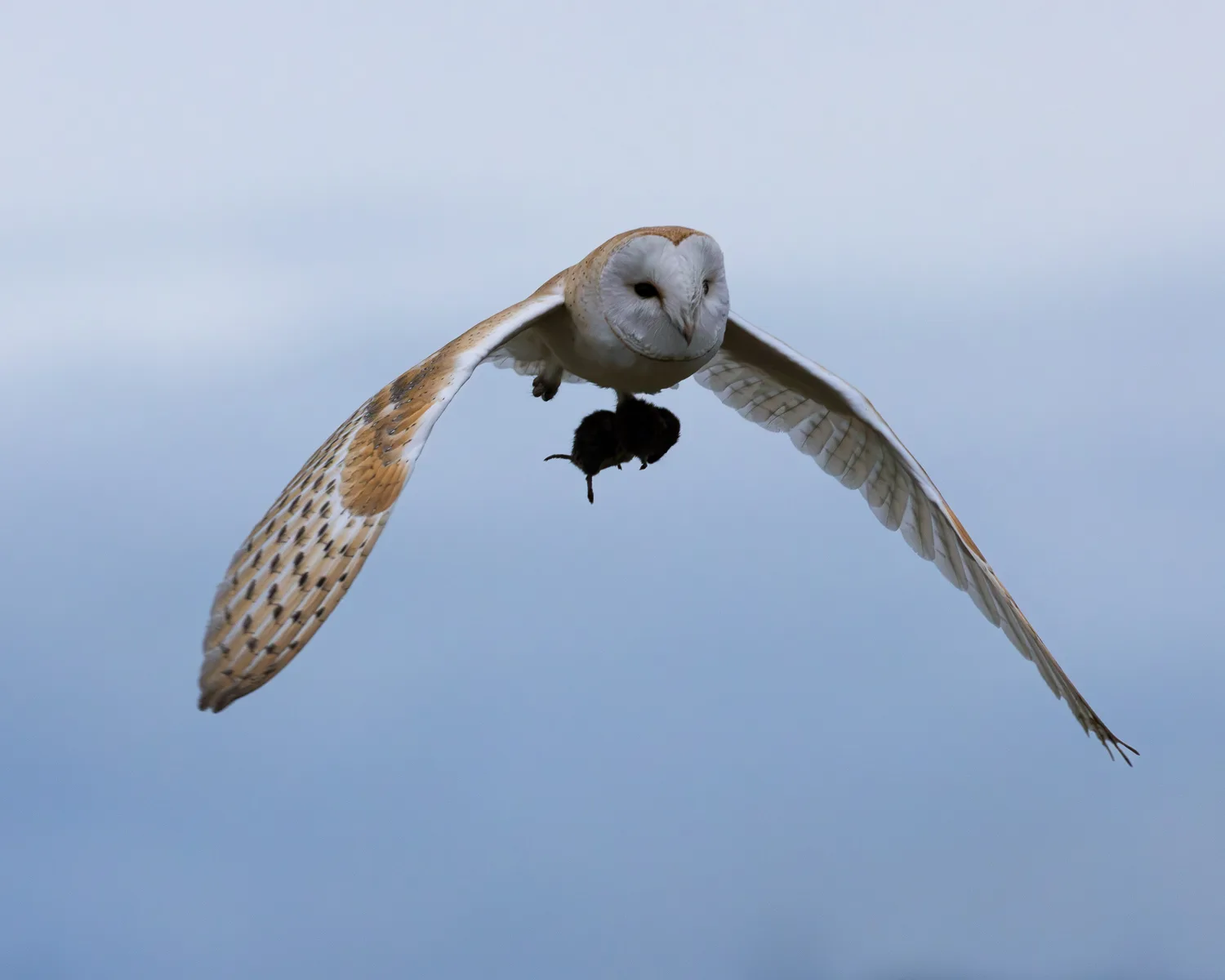
Barn owls are primarily crepuscular, meaning their activity peaks around dawn and dusk. These low-light windows provide the perfect cover for barn owls to glide across fields unseen. If you’re not looking for them, you’ll probably never know they’re there; there’s a reason they’re nicknamed ghosts. For wildlife photographers, dawn and dusk are the most reliable times to witness a barn owl hunting. Even with that knowledge, nothing is guaranteed. Weather, prey availability, and the season can all push barn owls outside their usual routine.
How does winter affect barn owl behaviour?
As resilient as they are, winter is by far the most demanding season for barn owls, especially for young birds. I struggle through winter wrapped up in multiple layers; how wildlife survives during these difficult months never fails to amaze me.
UK winters are becoming wetter, adding real pressure to an already difficult season. But it’s not the weather alone that puts barn owls at greatest risk; it’s what wet weather does to their ability to hunt. Waterlogged ground and reduced vole activity during storms can leave a barn owl unable to find enough food, and prey scarcity, not the cold or rain directly, is what the Barn Owl Trust’s own research shows drives winter mortality most.
During spells of prolonged wet weather, barn owls are often forced to adapt by hunting earlier in the afternoon, continuing through the night, or even emerging in the middle of the day. As the weather improves, it’s thought that some owls take advantage of the calmer conditions and create caches, banking extra food for when the weather turns ugly.
Seeing a barn owl hunting in the daytime isn’t necessarily a cause for concern; it’s a sign of resilience, finding food however and whenever it can, even when the UK’s winter weather throws everything its way.
The demands of the breeding season on barn owls
Throughout the breeding season, barn owl activity increases dramatically. Males hunt for both themselves and females during the incubation period, and once chicks hatch, both adults can often be seen hunting with increasing intensity.
Prey demand spikes as chicks begin to grow, and parents respond by extending their usual dawn and dusk hunting into longer stretches, sometimes hunting well beyond sunrise or before sunset, and even squeezing in short, random bursts of activity during the day. Some will cache extra food at the nest to help see the brood through
The breeding season generally extends through spring and summer, and successful parents can go on to raise multiple broods. With all of those hungry mouths to feed, it’s no surprise that barn owls are increasingly visible throughout this period. As wildlife photographers and observers, this is exactly the time to give owls plenty of space. They’re under enough pressure to provide as it is; the least we can do is respect their space.
Seasonal fieldcraft implications for barn owl photography
As photographers, understanding how barn owls respond to time of day and seasonal pressures gives us a huge advantage in the field. On a typical day, we can plan our activity around dawn or dusk, the most reliable windows for barn owl activity. Ideally, you need to be in position and concealed well in advance to avoid disturbing their natural behaviour.
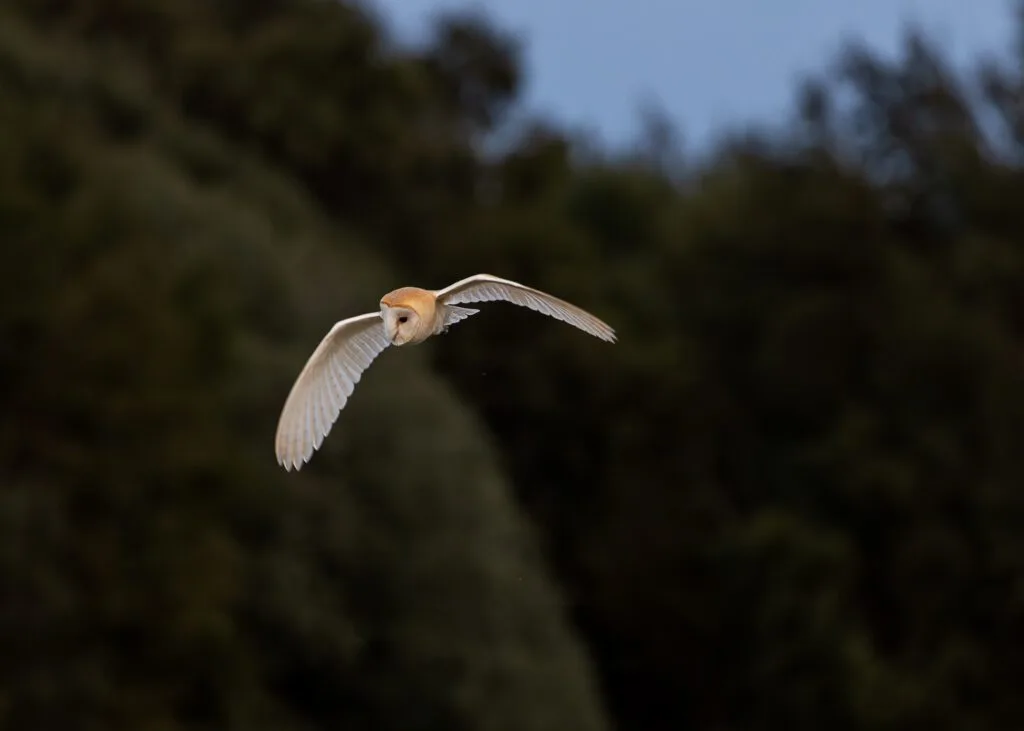
During relentless periods of wet weather, the most reliable time to see a barn owl hunting is the morning or afternoon immediately after a storm. We know owls are unable to hunt during wet weather, and so as soon as conditions allow, you can almost guarantee that they will be looking to catch up on lost time.
Extended hunting hours throughout the winter and breeding season can offer increased opportunities for photography, but respect the owl’s space regardless. These periods often reflect increased pressure on owls through scarcity or the demands of raising a brood. We don’t want to add any more pressure to these beautiful birds for the sake of a photograph. Keep your distance, respect their privacy, and allow them to hunt instinctively. A relaxed owl will present far greater photographic opportunities than a stressed owl.
The Art of Concealment
Blending in with your environment, AKA the art of concealment, is one of the most valuable skills you can develop as a wildlife photographer. Effective concealment allows you to observe and photograph barn owls without being seen, ensuring their behaviour remains natural and undisturbed. Some of my most memorable encounters have come from sitting patiently under makeshift hides, using simple camouflage netting to break up my outline. With a little care and consideration, you can become an unnoticeable part of the landscape and capture intimate moments with barn owls displaying natural behaviour.
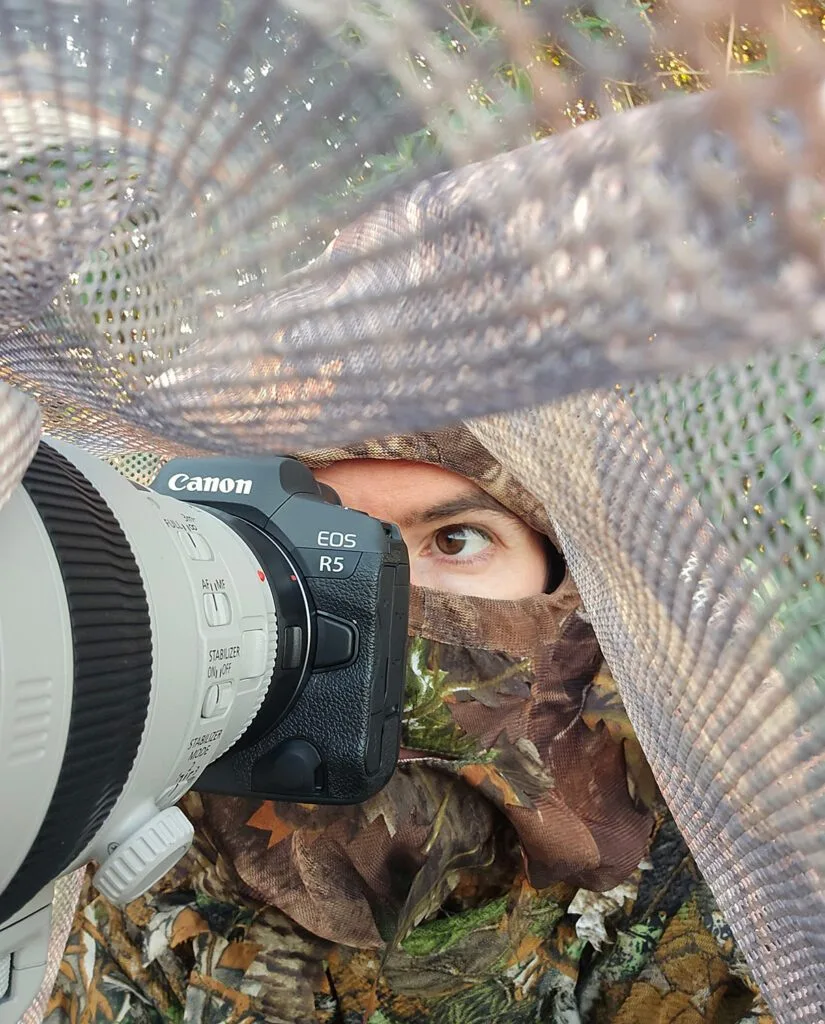
When barn owls don’t acknowledge your presence or register you as a threat, they will often pass closer and quarter fields more confidently. Blending in is an art. From lightweight scrims and netting to camouflage clothing and natural cover, each solution has its own place depending on the landscape and conditions.
Camouflage techniques for barn owl photography
The trick to successful camouflage is to tailor your strategy to the landscape. Subtle colours and patterns can help you blend into the landscape and prevent you from sticking out like a sore thumb. A few reliable, budget-friendly camouflage options include:
- Natural cover: using features the landscape already provides, such as hedgerows, trees, and long grass, to blend in. Wear colours which complement your surroundings, but be careful not to damage the landscape. Remember the golden rule: leave no trace.
- Camouflage netting and scrims: inexpensive options that offer genuine flexibility. Draping netting or a scrim yourself and your camera equipment breaks up your outline, rendering you a seemingly natural part of the landscape. These are often my go-to approaches for concealment.
- Pop-up hides: pop-up hides can be great tools for disappearing into the landscape, but they’re not as portable or flexible as makeshift hides made from netting. The view from inside is also often restricted, which isn’t ideal given that owls can move unpredictably.
- Clothing: camouflage or muted, earthy colours are favoured for blending into the background. Wearing bright colours will only draw attention to yourself.
- Distance: the further away you are, the less likely you are to be spotted or identified as a threat to hunting barn owls. Longer focal length lenses can help overcome the distance between you and a hunting owl.
The best approach to camouflage is to familiarise yourself with the landscape and choose a solution that allows you to become part of your natural surroundings. Camouflage isn’t an excuse to push closer to hunting barn owls, nor is it a guarantee of remaining unseen. Movement and noise are by far the biggest giveaways, so staying quiet and still matters more than any camouflage setup.
From experience, it pays to get yourself comfortable and have everything you’re likely to need within reach: spare batteries, extra layers for the cold months, and most importantly, the travel mug of tea.
Recommended Camera Gear for Photographing Barn Owls
With your fieldcraft knowledge in place, it’s time to talk camera gear. You don’t need an expensive setup to photograph barn owls respectfully, but there are a few things worth considering, especially lens choice.
Camera bodies
Given that barn owls are typically most active around dawn and dusk, you’ll occasionally be pushing your camera body to its absolute limits in terms of low-light performance. You’ll want a camera body that can handle high ISOs effortlessly without sacrificing too much dynamic range or image quality.
And then there’s autofocus. Barn owls often dip and dive unpredictably, making responsive autofocus a feature worth its weight in gold for tracking birds in flight.
A few important features to consider for photographing owls include:
- High-ISO performance: allows you to comfortably use higher shutter speeds when the light begins to fall.
- Fast, reliable autofocus settings: advanced subject and eye detection features reduce the chances of missing key moments of behaviour.
- High burst rates: help to capture the perfect positioning of owls during rapid bursts of movement.
- Crop sensors: apply a focal length magnification, meaning you can achieve a tighter field of view of your subject. Example: A 400mm lens used with a full-frame Canon camera is equivalent to 640mm on a crop sensor body (400mm x 1.6 crop factor).
- Stacked sensor technology: dramatically faster readout speeds mean quicker autofocus tracking and less distortion when photographing fast wingbeats or sudden movement.
- High-resolution full-frame sensors: exceptional dynamic range with plenty of room for cropping in post-processing.
Modern mirrorless cameras take most of this in their stride, but don’t worry if you’re still using a DSLR. Higher-end DSLR cameras are still more than capable; you’ll just need to pay a little more attention to technique and timing.
Camera bodies are only half of the equation. To photograph barn owls ethically, you’ll need to pair your body with a reasonably fast, long-reaching lens that allows you to keep a respectful distance without the owl appearing lost in the frame.
Lenses
We’d all love to have a 400mm f/2.8 prime lens in our kit bag, the cream of the crop for low-light wildlife photography, but for most of us, it remains exactly that: a dream. Slower primes like Canon’s well-regarded 400mm f/5.6L are a different story, still sharp, still popular with wildlife photographers today, and far more attainable, especially secondhand.
Fortunately, I’m a firm believer that fieldcraft and technical skill will always outweigh gear. You can absolutely capture intimate photographs of barn owls without owning high-end equipment. There is one caveat, though: a focal length of at least 400mm is generally considered the baseline for photographing barn owls from a respectful distance.
With so many options available, the right lens comes down to what suits you and your budget. Here’s a short breakdown of some features to consider:
- Focal length: 400-600mm is the sweet spot for barn owls.
- Aperture: f/2.8-f/5.6 will keep you shooting when light levels begin to fade.
- Zoom lenses: (100-400mm, 150-600mm) offer flexibility when owls move unpredictably through their environment.
- Prime lenses: (400mm, 500mm, 600mm) offer exceptional image quality and low-light performance, but they’re generally much heavier and bulkier, making hand-held shooting challenging.
- Extenders: help to increase the focal reach further, but at the cost of losing some light and autofocus speed, which is worth bearing in mind given how much you’ll rely on responsive AF for a fast-moving barn owl.
- Image stabilisation: works a treat when shooting hand-held in low-light conditions, allowing you to use dramatically slower shutter speeds.
No matter which lens suits you best, one thing is certain: you’ll need support. Photographing barn owls is a true test of patience. It’s not unusual to wait hours for an appearance, and holding onto your camera equipment for that long will quickly take its toll. That’s where tripods, monopods and beanbags come in.
Tripods and support
If you want to build bigger forearms, try holding a long lens for two or three hours straight while waiting under your hide for a barn owl to appear. Fortunately, tripods, monopods, and beanbags make life much easier.
I almost always use my tripod when out in the field; not only does it support my camera setup, but it also provides a solid base to attach my camouflage netting to. A dependable support system makes a real difference to image sharpness by reducing the risk of motion blur that comes with hand-held shooting during long, low-light sessions.
Additional accessories
A few optional extras that make life easier out in the field:
- Spare batteries.
- Backup memory cards.
- Rain cover.
- Head torch.
- Comfortable cushion/mat, if sitting on the ground.
- Lens blower and microfiber cloths.
- High magnification binoculars.
None of the items above are essential, but they’ve all well and truly earned their place in my bag over time.
Camera Settings for Typical Barn Owl Encounters
When it comes to photographing barn owls, no two encounters are ever the same, and that’s the real beauty of it. Every moment is a constant balancing act between managing light, movement, and composition while observing behaviour in real time. Barn owls appear without warning and move surprisingly quickly. Any technical decision you make needs to be instinctive and calm; you may not get a second chance.
For most encounters, manual mode paired with auto ISO will do most of the heavy lifting. In high-pressure situations, the less you have to worry about, the more you can focus on composition and fieldcraft. Don’t overwhelm yourself with settings; make life easy, focus on the things that matter and most importantly, enjoy the moment.
The scenarios below cover some of the most common situations you’ll run into while photographing hunting barn owls.
How to Photograph Barn Owls Flying Towards You in Low Light
Witnessing a barn owl flying straight towards you is one of those moments that will stay with you forever, but it can be a challenge to capture. Seconds. That’s all the time you have to make the most important decisions that determine success or failure. Barn owls move much faster than they appear to, with their silent flight and soft wingbeats masking their true speed. Freezing the moment, especially in low light, will often push your camera to its absolute limits.
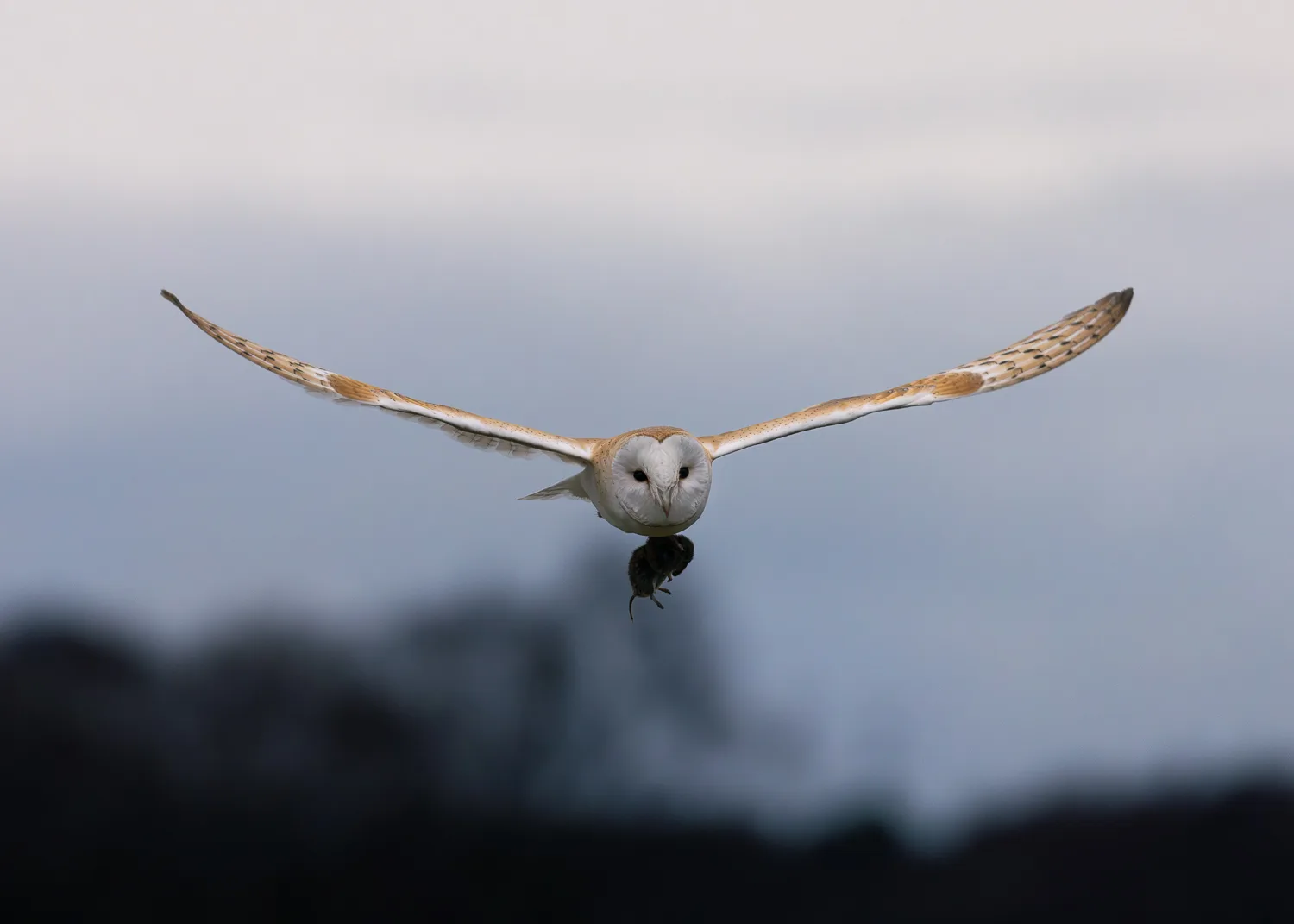
Settings for low-light flight
Low-light flight is one of the most demanding scenarios you’ll encounter, pushing high-ISO performance to the limit. Typical settings fall within the following ranges:
- Shutter speed: 1/1600 – 1/2500s
- Aperture: f/2.8 – f/5.6 (wide-open)
- ISO: 1600 – 12,800
- AF mode: Continuous with subject tracking and eye detection
- Drive mode: High-speed and high-speed+
- Exposure compensation: +/- 1/3 to +/- 1 EV depending on light and position of the owl.
A fast shutter speed and lens are non-negotiable in low-light conditions. To freeze the motion of the owl as it moves rapidly towards you, anything slower than 1/1600s simply won’t cut it. You may get a lucky shot or two, but for consistent results, shutter speed is everything. Don’t be afraid to push your ISO up; noise reduction features in post-processing software have come a long way. It’s much better to capture a sharp, noisy image than to miss the opportunity altogether.
If your camera gear struggles to achieve the shutter speeds needed to freeze the barn owl’s motion in low light, don’t worry; not every image needs to be pin-sharp. Sometimes experimenting with slower shutter speeds to illustrate and emphasise movement can produce unique and breathtaking results.
Fieldcraft: in-flight barn owls
The closer a barn owl approaches, the more concealment and slow movements matter. Remember, barn owls are sensitive to motion. If, as the owl nears, it notices the movement of you panning or adjusting your composition, it will veer off suddenly. Our responsibility is to capture moments respectfully, without disrupting their natural behaviour. Set your composition ahead of the owl’s flight path, and allow the owl to move into your frame.
Photographing Hovering Barn Owls
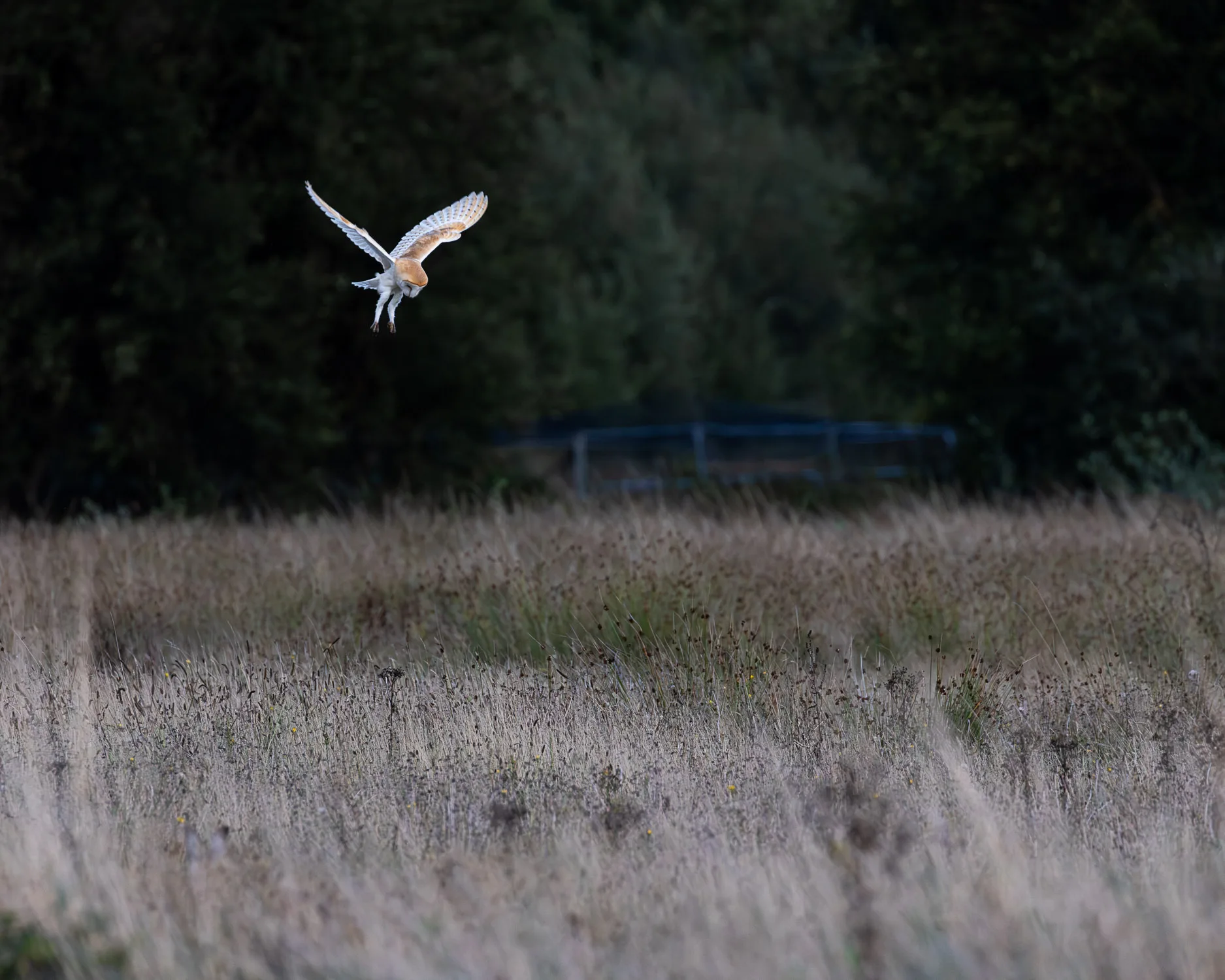
When a quartering barn owl detects movement, it will pause and begin to hover in mid-air. This is the moment when you know you’re about to witness a master at work. In a true display of natural ability, the owl intently locks its gaze onto the ground, holding its head perfectly still, with soft, deep wing-beats keeping it aloft. Without warning, its posture shifts and its body angles forward, its talons drop, and the tension builds. In one explosive motion, it lunges to the ground with jaw-dropping precision, before re-emerging with an unfortunate field vole.
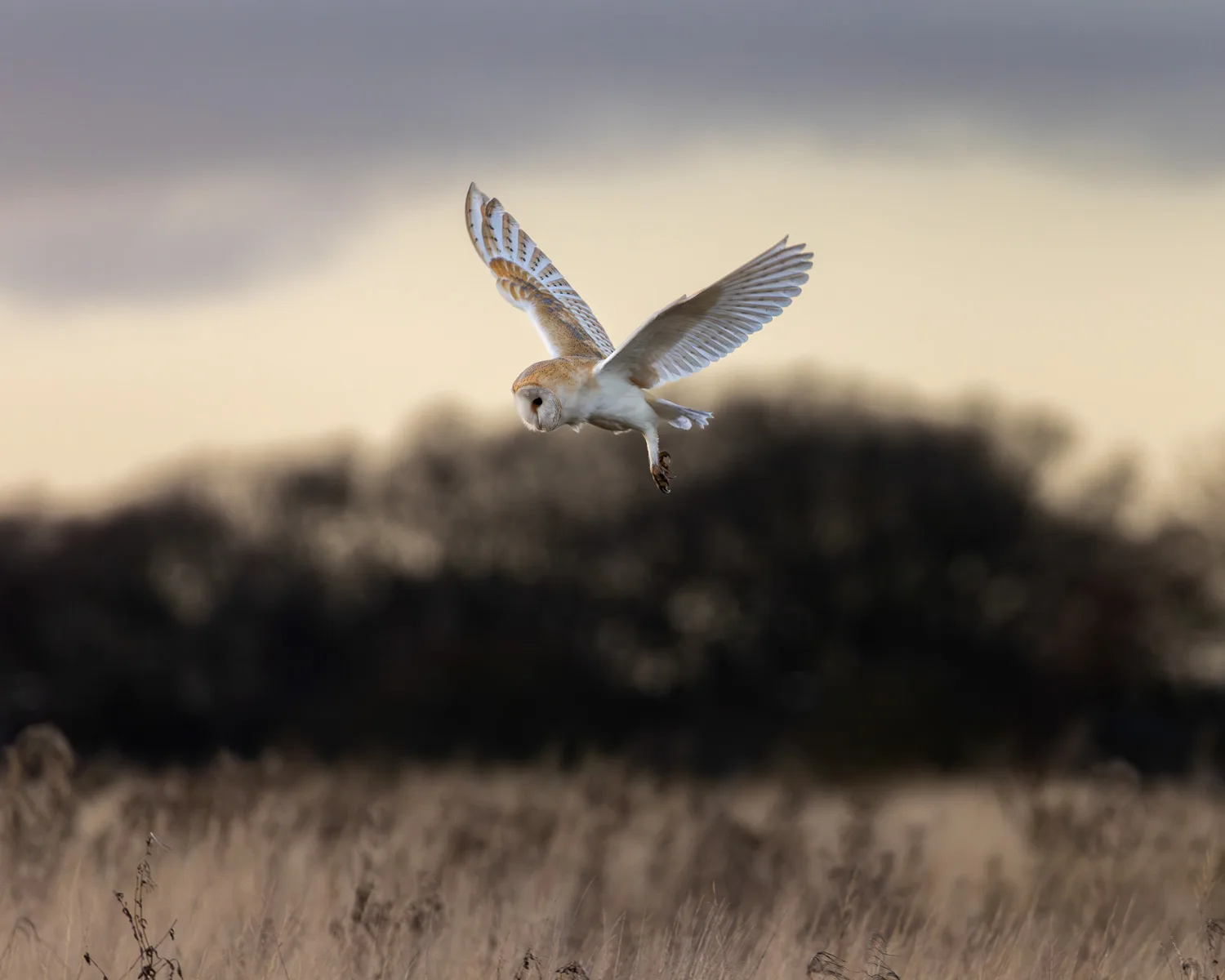
Settings for hovering behaviour
Hovering barn owls offer some of the best opportunities to express creative freedom. When the owl is suspended in mid-air, you can choose to emphasise motion or freeze it entirely. Slower shutter speeds of between 1/50 and 1/200s introduce a sense of movement, blurring the beating wings but keeping the head and eyes tack-sharp. Faster shutter speeds (1/1000 to 1/2000s) keep you ready to capture the explosive moments as they unfold.
Typical settings for hovering barn owls are as follows:
- Shutter speed: 1/50–1/2000s
- Aperture: f/2.8–f/5.6
- ISO: 800–12,800
- AF mode: Continuous AF with subject and eye tracking
- Drive mode: High‑speed burst or high-speed+
- Exposure compensation: –1/3 to –1 EV
When a barn owl pauses to hover, it’s time to lock in and stay focused. You don’t have the luxury of time when the owl decides to strike; it’s over in the blink of an eye, and you need to be ready for it. High-burst shooting modes are invaluable here as they allow you to capture micro-adjustments in wingbeats and posture that are almost impossible to anticipate.
Subject tracking and eye detection make a real difference for holding sharp focus as the owl commits to a dive. This is where tracking sensitivity comes into play. Tracking sensitivity is a setting that determines how your camera should respond to distractions and environmental elements your subject interacts with. A “sticky” setting works well for tracking hovering barn owls, especially as they dive, preventing focus from being pulled to the grass or vegetation in the field.
Fieldcraft: hovering behaviour
As always, barn owls will display natural behaviour as long as they don’t feel threatened or disturbed. Staying low and avoiding any sudden movements is essential; even a slight nudge of your camera can draw the gaze of the owl and cause them to abandon the hover or leave the area entirely. In a light breeze, try to position yourself with your back to the wind, as this can often make all the difference. Barn owls will often hover into the wind, giving you a much greater chance of capturing the moment head-on.
How to Photograph Perched Barn Owls
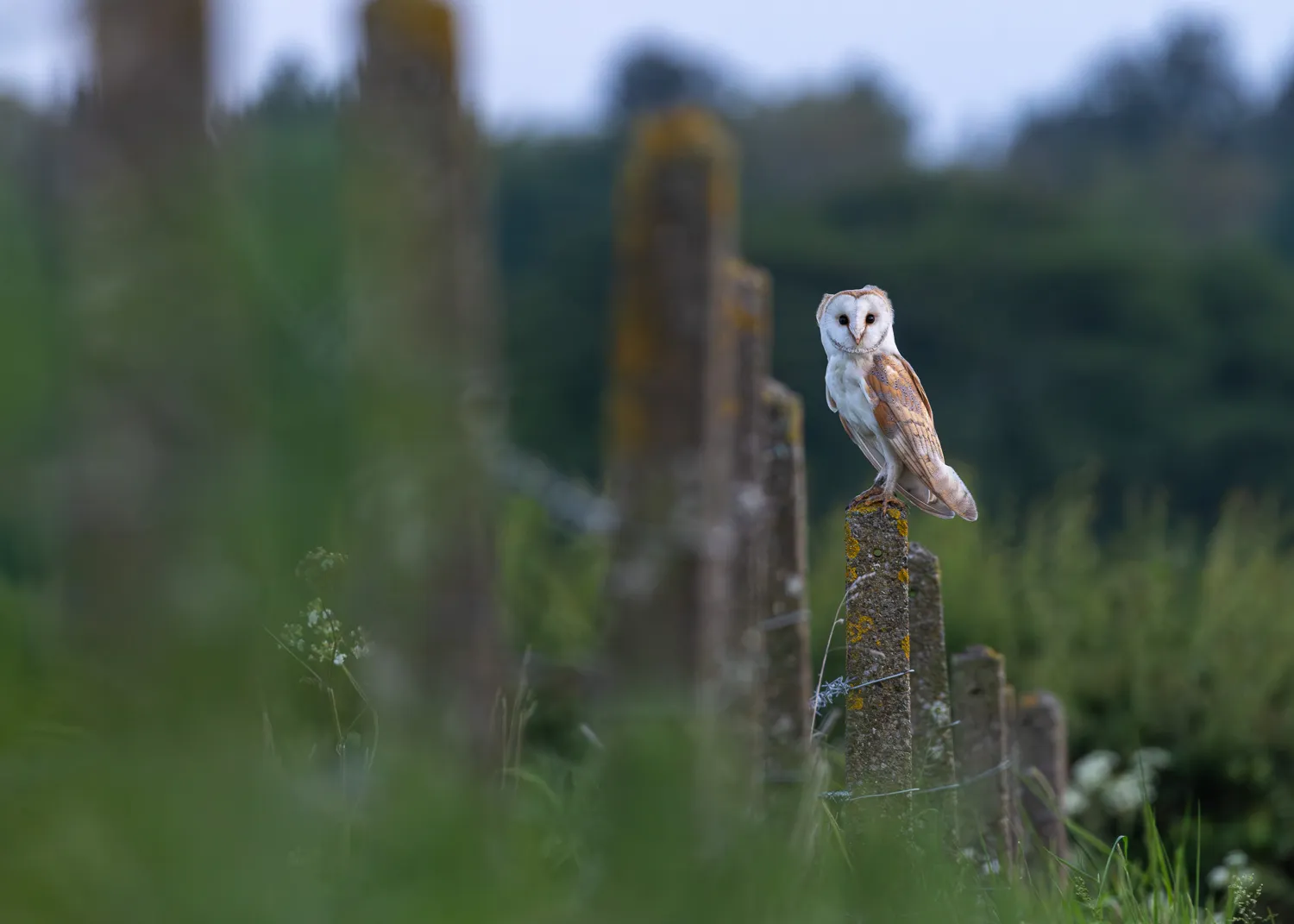
The moment a quartering barn owl drops down onto a nearby fence post is guaranteed to make your hair stand on end. It’s a real heart-in-the-mouth experience, and capturing it requires a calm and methodical approach. A perched barn owl is on high alert, listening for the faintest rustle in the tall grasses. It’s one of the best opportunities to observe behaviour and to frame the owl within its natural environment.
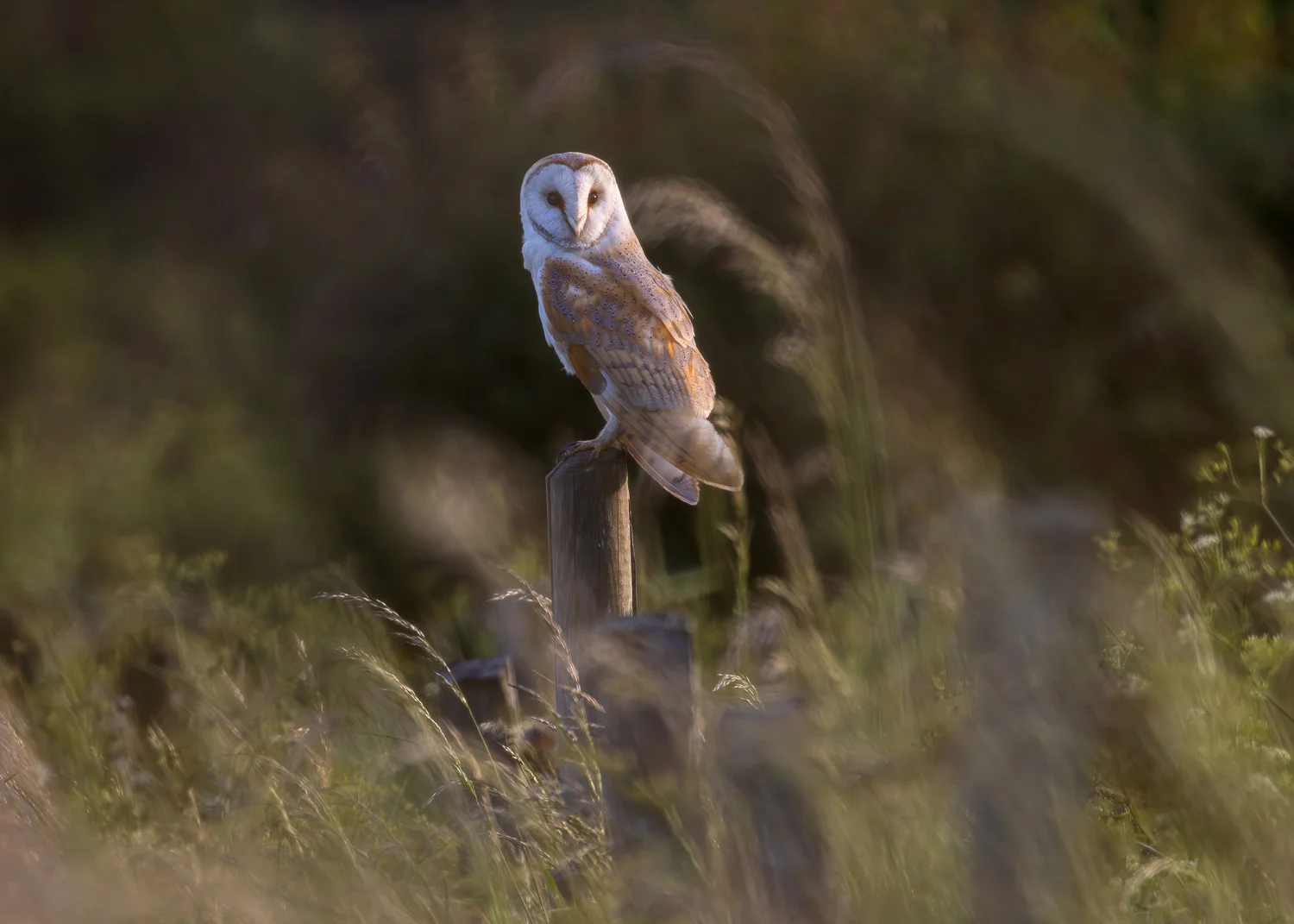
Camera settings for perched barn owls
Settings will vary depending on the amount of available light, but generally, perched owls give you greater flexibility than any other scenario. Typically, you can expect to use settings within the following ranges:
- Shutter speed: 1/200 – 1/1000s
- Aperture: f/2.8 – f/8 (widest available aperture is recommended for low light)
- ISO: 1600 – 12,800+
- AF mode: Single point
- Drive mode: Single shot or short burst
- Exposure compensation: -1/3 to -1 EV
- Image stabilisation: On if available and shooting handheld (mode 1)
A perched barn owl gives you the luxury of slowing things down. Your thought process can be more considered, and as long as your movements are slow, you have time to refine your composition. The goal is to simplify the background and ensure that the barn owl is the clear focal point of the image.
Shutter speeds and apertures will vary depending on how close the owl is, how active it is, and the available light. The closer the owl, the shallower the depth of field. Stopping down will help keep the areas that matter tack-sharp. Drive mode is situational: sometimes, subject tracking can struggle to lock focus on a perched barn owl. There’s nothing more frustrating than having environmental features, such as long grass, pull focus, especially if there’s a slight breeze. Using a single point is one less thing to worry about, leaving you free to concentrate on the technical settings that matter.
Don’t be afraid to switch to manual focus for complete control of your focus point. In complex environmental settings, manual focus can often be the difference between success and a missed opportunity.
Fieldcraft: perched owls
Perched barn owls stay sharply tuned to their surroundings, even at rest, ready to react to the faintest movement in the grass below. Keep any movement slow and minimal. Stay exactly where you are, as tempting as it is, don’t try to edge forward for a closer view. Perched owls can display intimate behaviours such as stretching, preening, or leaning towards any movement they detect. Be ready for those moments; they’re some of the most photogenic behaviours to capture.
Storytelling and Composition
Seeing a barn owl is only part of the experience; sharing its story is where the real emotion comes through. This moment is yours, a chance to capture your own connection with these remarkable birds. Composition and storytelling bring all of the intimate details together through creative expression. I rarely go into the field expecting to capture a specific image. I let the barn owl’s behaviour dictate the shot, capturing what’s true to the moment rather than forcing a composition.
Composition is a reflection of the life of the barn owl. It allows you to illustrate how it lives, how it hunts, and how it behaves. There’s a common belief in wildlife photography that your subject needs to fill the frame. While tight portraits have their place, there’s so much more to be told from stepping back slightly and considering the environment.
Wider-angle environmental images frame the story. They provide context to behaviour and add a sense of scale to the composition. Creative freedom is there for the taking, and the section below will help you in the right direction.
Environmental storytelling
Environmental storytelling is where your frame captures the bigger picture. It captures depth, scale, and emotion in ways tight crops can’t achieve. They invite the viewer into the barn owl’s world, the rough grass, weathered fence posts often used as vantage points, and the last light subtly gracing the landscape. When carefully considered, these elements don’t distract from the owl; they add real emotional value.
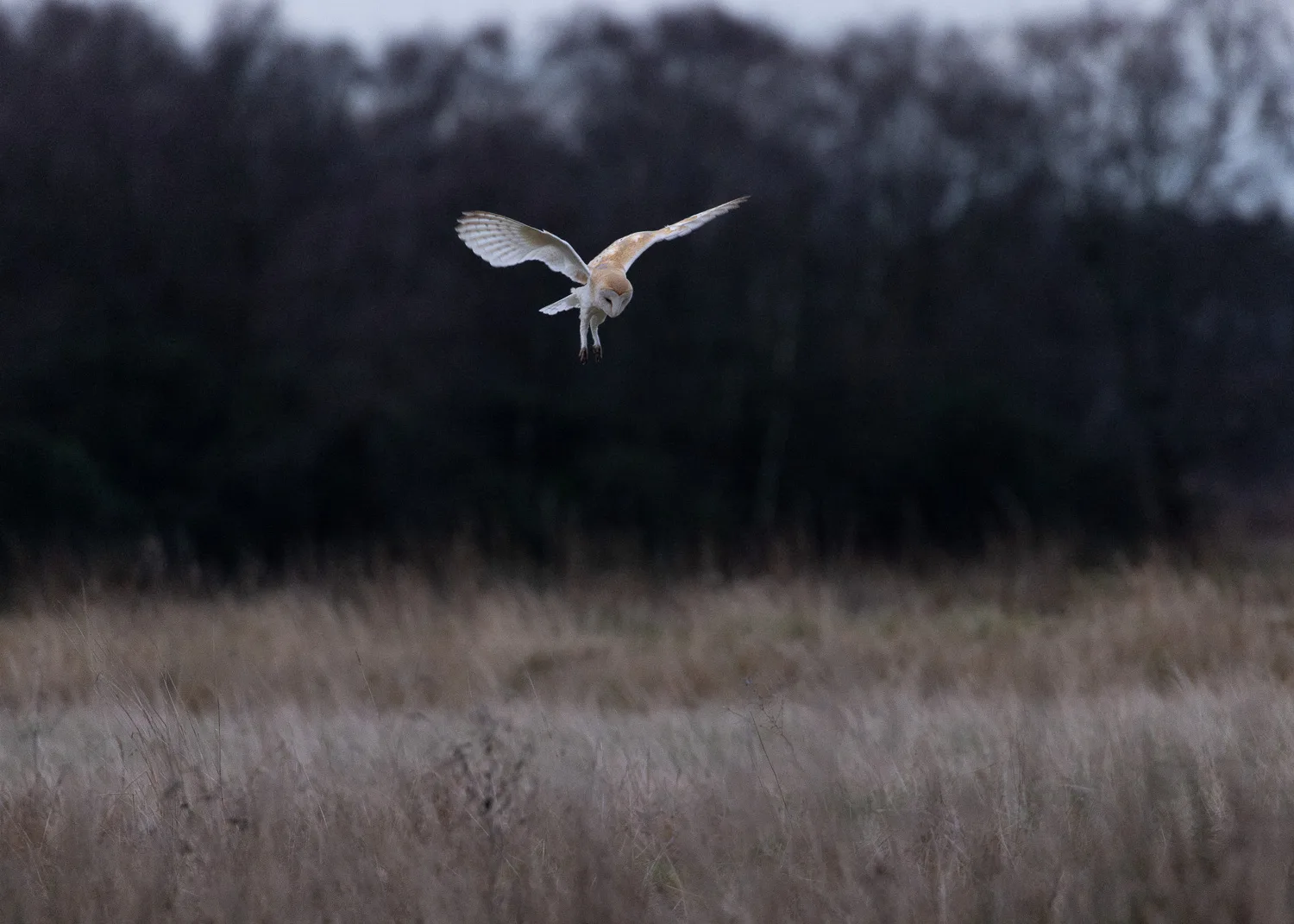
Environmental compositions create a sense of place, revealing the intimate relationship between the barn owl and its habitat. Sometimes they’re rough and ready, but that’s exactly how nature should be.
The following tips can help environmental storytelling feel intentional rather than accidental:
- Natural leading lines. Shapes, textures, and natural features can direct the viewer’s eye towards the barn owl. Hedgerows, fence lines, and even the direction of grasses blowing in the wind are all features to look out for.
- Distance and scale. Zooming out can illustrate a sense of scale, particularly in large fields of long grasses surrounded by typical countryside elements. A little care is needed to ensure the barn owl doesn’t become lost in the frame.
- Contrast. The difference between light and shadow can create a sense of depth in the landscape. Considering the direction of light can help ensure the important elements catch the viewer’s eye.
- Illustrate behaviour. Environmental compositions are great for capturing behaviour with context. Quartering, hovering, and perched on weathered posts, each of these behaviours feels so much more intimate when captured with the context of the surroundings.
- Embrace imperfection. Long grasses, the skeletons of decaying plants, broken trees, and branches. These are the details that make an environment feel real rather than staged.
Environmental storytelling is about honesty, presenting the owl as it is, without crafting an image that feels overly polished or unnatural.
Negative space and the power of simplicity
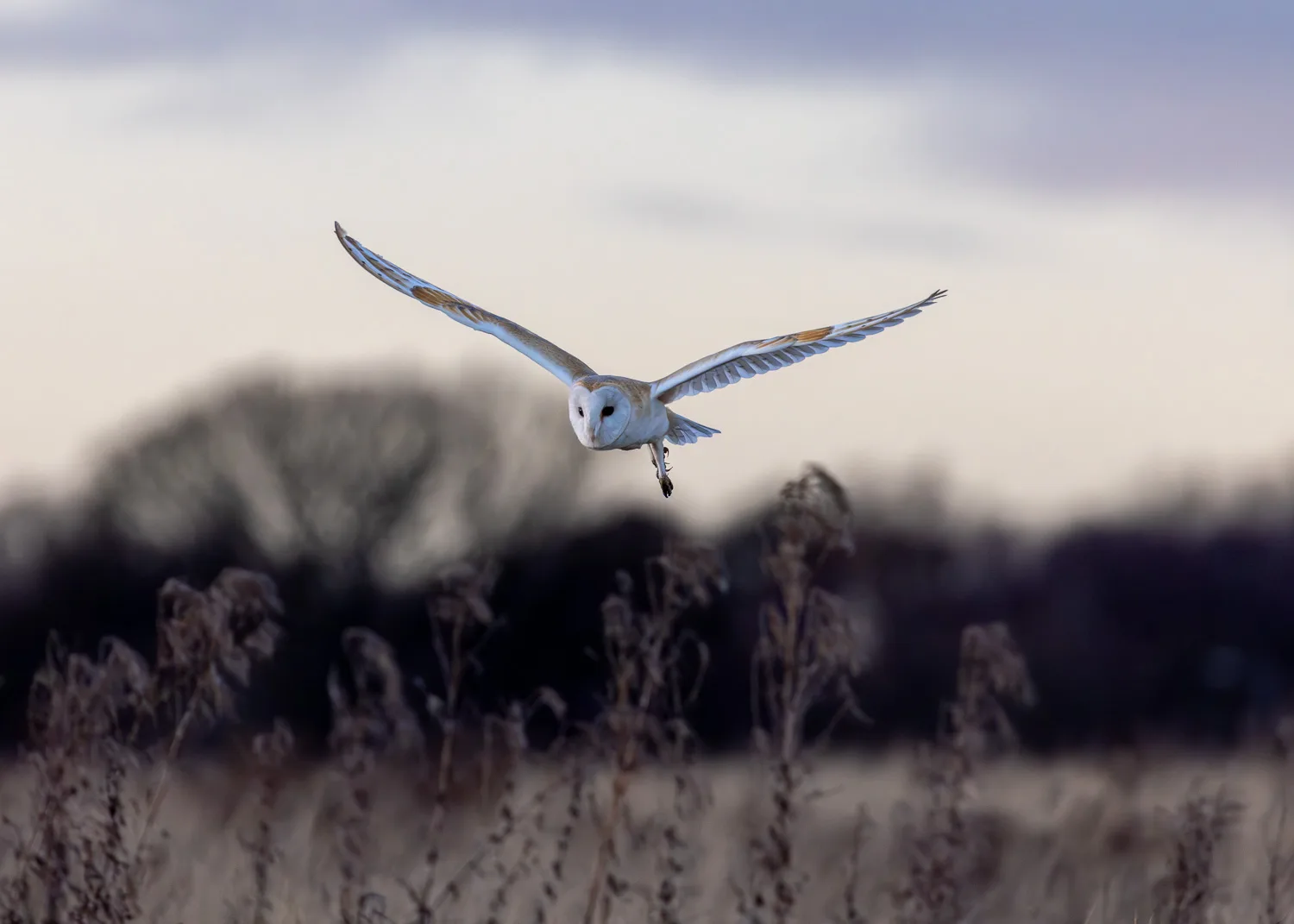
Negative space is easily overlooked in the heat of the moment, especially when your brain screams at you to fill the frame. Negative space creates calm. It gives your subject the breathing room it needs to illustrate emotion and direction of movement. Used intentionally, negative space emphasises a considered approach to composition.
Negative space is an ideal tool for photographing barn owls, as it illustrates their unpredictable movement. Leaving plenty of space in the direction of travel allows the owl to glide gently through the composition. Negative space also gives you licence to bend the so-called rules of composition. Creatively, of course.
In practice, this might mean leaving plenty of space in the direction of travel, or using the rule of thirds to place your subject in the left or right third, leaving the rest of the frame empty or minimal. Positioning the owl off-centre emphasises the unpredictability of its movement, and keeping the composition simple, avoiding anything that competes for attention, reinforces that sense of calm. High-key images, a blank sky or a minimal landscape, can push this even further.
Negative space is about trusting your ability and the process. As long as you compose your images with purpose, allowing plenty of breathing space, you’ll convey the unpredictable nature and emotion of barn owls in their natural environment.
Final Thoughts on Ethical Barn Owl Photography
Photographing wild barn owls is as much about fieldcraft and respect as it is technical skill and patience. It’s about developing a connection with nature and with the iconic barn owl itself. The more time you spend observing and listening to the landscape, the more it will reveal. The long rustling grasses and the soft squeaks of field voles; eventually, you’ll be able to recognise even the smallest of signs that pave the way to those elusive, magical encounters.
Barn owls are an absolute pleasure to photograph. Capturing their unique behaviour, masked by the cover of near darkness, will always give me goosebumps. Every encounter is a privilege and a chance to observe the beauty and the resilience of one of the UK’s most captivating owls.
Throughout this guide, there has been a consistent emphasis on an ethical approach to photographing wild barn owls with respect and care. Fieldcraft and concealment are essential skills to develop for any wildlife photographer. Not just for barn owls, but for all UK wildlife. Capturing natural moments is dependent on your ability to become one with the landscape. Leave no trace and respect the wildlife codes of conduct.
Photographing barn owls hunting over rough grasslands is a genuine creative challenge. Capturing their unique behaviours through considered compositions is the most rewarding way to tell their stories. Environmental storytelling and negative space are great for illustrating context and the connection between the owl and its habitat.
And yet, even with all of this knowledge, barn owl photography offers no guarantees. Perfect conditions are never a promise of a sighting. Nature does what it wants, when it wants. As winter tests the barn owl’s resilience, photographing them tests ours. This is exactly why patience, respect, and humility are just as important as any technical skill. I covered this subject recently in my Field Notes, a story from a morning of near-perfect conditions on paper, yet no owl to be seen. It happens to the best of us, more than you’d imagine.
FAQs
What focal length is best for photographing barn owls?
A long focal length helps you keep a respectful distance while still capturing natural behaviour. Lenses in the 400–600mm range are commonly used for wild barn owls, but the exact focal length matters less than staying far enough away that the owl never knows you’re there. Good fieldcraft, patience, and blending into the landscape are far more important than reach.
How do you photograph barn owls without disturbing them?
Patience and fieldcraft are key. Arrive early, stay low, and consider using camouflage to blend in with your surroundings. Quartering barn owls are drawn to motion, so keep still and give them a respectful distance. As long as you’re patient and considerate, they won’t recognise you as a threat.
What time of day are barn owls most active?
Barn owls are crepuscular and therefore most active around dawn and dusk, with the best chances of seeing natural hunting behaviour during the late evening. In winter, extreme cold and challenging weather can lead to more daytime activity.
Where is the best place to find wild barn owls?
Look for open farmland, rough grassland, meadows, and field margins where small mammals are abundant. Signs such as pellets, whitewash, or favoured perches can indicate regular hunting routes.
How close can you get to a barn owl?
You should never try to approach a barn owl deliberately. Let the owl dictate the distance by remaining still and allowing it to pass naturally. If an owl changes direction, looks repeatedly in your direction, or alters its behaviour, you are too close. Never intentionally disturb a barn owl, and be aware that disturbing nesting owls specifically is a criminal offence under UK law.
How can you tell if a barn owl is stressed or disturbed?
A disturbed barn owl may change its flight path, hesitate before hunting, repeatedly look toward you, or leave the area altogether. Any movement away from relaxed, natural hunting behaviour is a sign to back off and give the owl more space.
Best guide I’ve come across thanks so much! We usually have a couple of barn owls hunting around our local area but I haven’t seen any at all since last summer 😭
Thanks, Steph! I’m in the North West, and it’s been a struggle here too. Speaking to friends across the country, it sounds like it’s been a bad year in general. A miserable autumn followed by non-stop rain for most of the winter, nightmare conditions for owls. Hopefully, spring and summer are good to us, and the owls get a much-needed chance to recover! Fingers crossed this guide comes in handy, and you get a sighting soon!
What a wonderfully written and detailed guide this is, some fantastic advice and tips
Looking forwards to using the information gleamed from your guide
Kindest regards
James howarth
Thanks so much, James — I really appreciate your feedback!
I wanted the guide to be both ethical and genuinely useful, so I’m glad it landed that way. I hope it helps you enjoy some special moments with barn owls out in the field, and I’d love to hear how you get on.
Cheers,
Simon
This is an excellent written guide, I have enjoyed reading it very much. I have learnt my fieldcraft from old books, my hero is Emma Turner. You may not have heard of Emma. She was a female photographer born in 1867 who took a photo of a Bittern in Norfolk which proved they were back from extinction. Back then female photographs were not as common as today. I would have loved to have found this article earlier but you are never too old to learn. I have been this week at my friends Barn Owl box hoping to see the chicks branch!! They sat on the shelf stretching and and flapping but didn’t leave As you say, sometimes you have one chance, It wouldn’t be fair to go again as they may have spotted me and came out after I left. I was in a hide which was put up the day before and I arrived an hour before they came out but I did get some photo at their home before they left, which tells the story. I also liked what you said about not always filling the frame, as it tells the viewer of your photo of the owls natural hunting ground and the landscape around which helps you to choose where to look to see these beautiful birds. I also liked the way you reminded us to be ethical whilst being a photographer. I struggle with some colleges who shall I say don’t always behave appropriately. Lastly I don’t have a mirrorless camera. Would the clicking of my camera be to disturbing to an owl? I know they look at me when they pass by but they don’t leave the area and continue about there business. I don’t move!! Thank you again. I shall keep looking at this article to help remind me of the tips you have included. I live in Norfolk and are lucky to have lots of Barn Owls around me.. they are my favorite birds. I can stand or sit for hours just watching them.
Hi Elizabeth, I hope you’re well! Thanks so much for your kind feedback; it means so much.
Emma Turner is an icon, you’ve learned from one of the best. How she achieved so much without modern-day technology is nothing short of inspirational.
It sounds like you have a great opportunity to capture fledging owlets, and by the sounds of it, it won’t be long until they’re out over the meadows learning to hunt for themselves. Regarding your camera shutter, it shouldn’t be a problem; you can always shoot single shots or very small bursts. Barn owls are quite sensitive to disruption in the form of motion and sound, but as long as your hide is a respectful distance away, you should be fine. They really are stunning birds; the more you watch them, the more you appreciate them. I’ve been watching a local male barn owl in particular for coming on two years now, and I still get goosebumps every time I see him quartering across his usual haunts. I’ve spent so much time appreciating them, I figured the least I could do was publish a guide to help others appreciate them ethically and draw attention to their declining population. The more we can do to help them, the better, right?
I hope you enjoy your time photographing them and spread the message of appreciating them ethically 🙂 If you need any help with camera settings or fieldcraft for barn owls specifically, feel free to ask.
Thanks again,
Simon